Lempert Outlines Four Forces Brands Must Confront to Sustain Consumer Trust
SHOPPER ATTITUDES AND BEHAVIORS are changing faster than at any time in recent history, and it’s putting food manufacturers on the defensive.
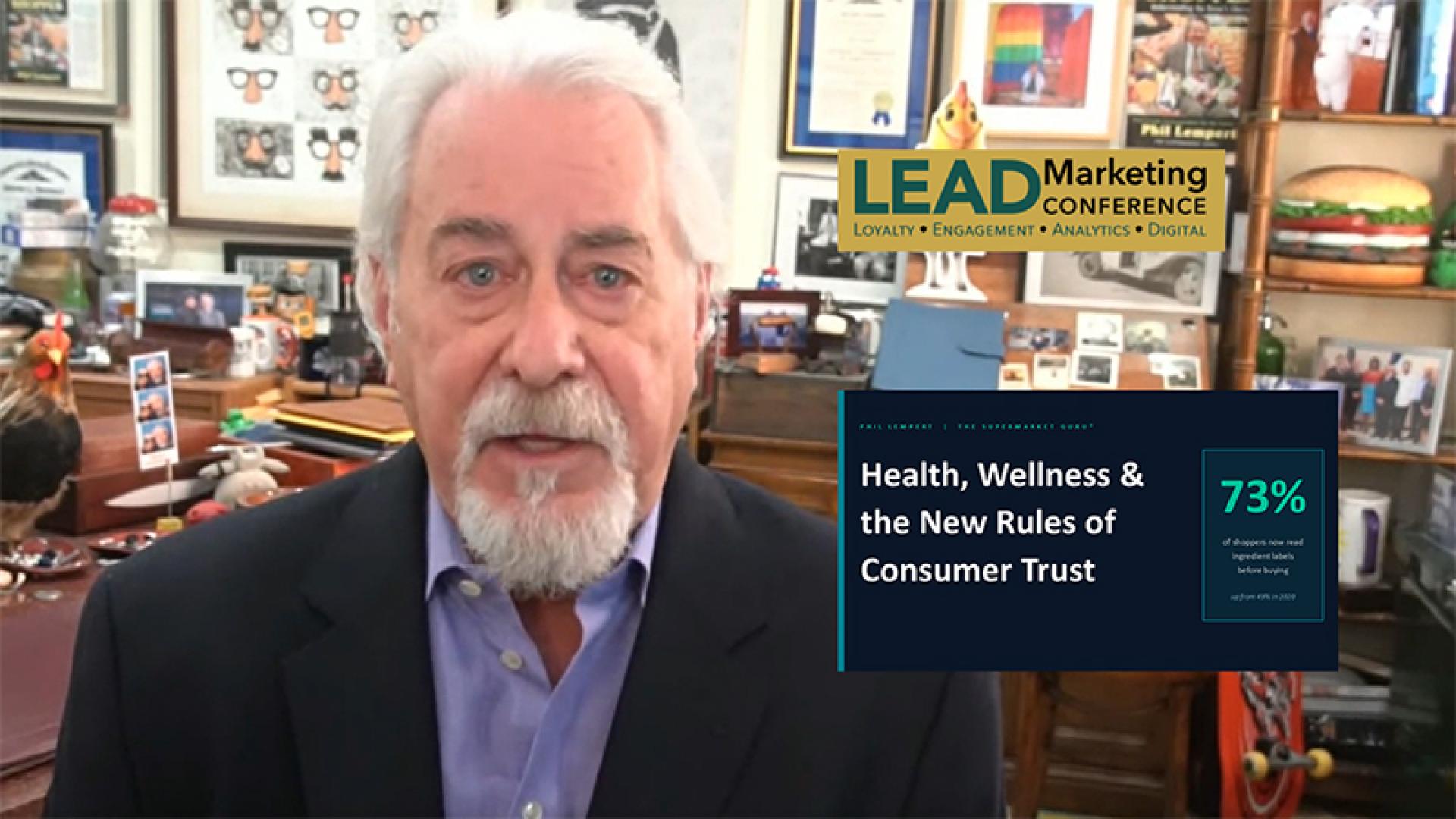
Phil Lempert, the industry observer widely known as The Supermarket Guru®, delivered some stern advice for CPGs at the Spring LEAD Marketing Conference, an all-virtual event, on May 27.
In his keynote presentation, titled, “Health, Wellness, and The New Rules of Consumer Trust,” Lempert outlined four powerful consumer forces that are driving change for the food industry and discussed their implications.
“What I'm watching right now, right now is something I haven't seen ever before,” Lempert said.
“It's not a trend. It's not a fad. It's a full-blown trust realignment between American shoppers and the food that they put in their bodies and the bodies of their children.”
Lempert outlined four foundational changes underway that are redefining the relationships between shoppers and brands. He followed with five strategic responses he believes food companies must confront to remain successful.
About the LEAD Marketing Conferences: Produced by CPGMatters, the events are focused on industry trends and innovation strategies for consumer packaged goods professionals. Learn More.
“Here's a number I want you to sit with. 73% of US shoppers say they now read ingredient labels before they buy a product. In 2020, that number was only 49%. So, the question isn't whether consumers have changed. They certainly have. The question is, has your brand changed?”
Lempert addressed four forces he said are simultaneously reshaping brands and their relationships with the shopper:
- The Health and Wellness Super Cycle that is structurally reorganizing what people eat and what they drink.
- Changing Label and Packaging Regulations which amount to a tidal wave of lawmaking in key states.
- Make America Healthy Again, a movement which has moved from a political slogan to actual policy that has real teeth.
- The Food Dye Reckoning, which transformed from a niche activist issue into front page crisis for some of the biggest brands in the world in just a matter of weeks.
New health and wellness consciousness
What he called the “Health & Wellness Super Cycle” is only driven in part by the rise in GLP-1 weight-loss medications. It also reflects a broader set of socially-influenced behaviors he called “conscious consumption.”
More consumers are seeking both “free-from” formulations as well as desired nutrients, such as added protein and probiotics. He advised brands to retire “better-for-you” sub-brands and “mainstream your health credentials directly on the primary label.”
Said Lempert, “Health and wellness is not a trend. It's a structural reorganization of consumer behavior.”
As a caveat, he urged food companies to establish an internal review process to ensure the accuracy of functional product claims, noting that the FTC and FDA are presently watching these more carefully than at any point in decades.
Packaging patchwork widens
Lempert noted that the FDA's pending healthy labeling rule would create a standard icon, a symbol that would appear on the front of the pack indicating a product meets updated healthy criteria. This rule is about to be updated for the first time in 30 years.
At the same time, dozens of state regulations have been or are being enacted regarding packaging materials and recyclability claims. So-called EPR rules (Extended Producer Responsibility) vary by jurisdiction, complicating compliance. His advice: Ensure new packaging will conform with the most stringent requirements and distribute nationally. For many products, California’s new rules may prevail.
Health consciousness that transcends politics
New scrutiny of commonly-used food additives, including food colorings, has been turbo-charged by the Make America Healthy Movement along with some political baggage from the current FDA leadership. Whatever your views, there’s no ignoring this, Lempert insisted.
“Food dyes went from a niche consumer activist issue to a front page brand crisis faster than almost anything that I've ever seen in three decades of covering this industry.”
The industry should anticipate a revisiting of many ingredients which have enjoyed long standing GRAS (Generally Recognized as Safe) status. The FDA has already ruled that Red Dye #3 must be removed from food products by January 2027. Red 40, Yellow 5, Yellow 6 are under review. In California, CA AB 418 is creating federal pressure.
Polls reveal that MAHA consciousness is already widely embedded, Lempert said. “Consumer data is not going to care about party affiliation. A political poll from March 2026 found that 73% of Americans support reducing artificial additives and food. That support is remarkably consistent across party lines. This is not a left issue or a right issue. This is a parent issue.”
Formulations under scrutiny
Lempert observed that increased awareness is opening the door to legislative and regulatory restrictions on so-called “ultra-processed” ingredients like oils, starches, protein isolates, and synthesized additives.
Regulators and industry are paying closer attention to the NOVA classification of food ingredients. Developed by researchers at the University of São Paulo, categorizes foods based on how much industrial processing they undergo.
MAHA consciousness is also a factor here. Lempert warned of the growing patchwork of state-level label regulations and the importance of proactive reformulation. “Whether or not NOVA based legislation passes in your top markets. You need to understand where your products land on this scale. Know your NOVA score.”
He also observed that natural colorants typically cost “three to eight times” what synthetic equivalents cost. “That margin impact has to be built into brand planning now because reformulating under crisis conditions is more expensive than reformulating proactively.”
Strategic responses for brands
Against this dynamic backdrop, Lempert advocated “five moves that matter” for food manufacturers to sustain market position in the next era:
- Reformulate Proactively. Reactive reformulation costs 3–5× more — in money, media, and trust. Build a 36-month ingredient risk register.
- Become the Most Transparent Brand. In a low-trust environment, information is a competitive moat. Adopt real QR codes, real explanations, real dietitian relationships.
- Treat Compliance as Brand Strategy. The brands winning in 2027 will look like they knew the regulations were coming. Compliance IS brand leadership.
- Invest in the MAHA Consumer Now. She's vocal, organized, and growing. Earn her trust and she becomes your ambassador. Dismiss her and she becomes your opponent. The ROI is unambiguous.
- Make Health a Supply Chain Commitment. Clean labels that hide supply chain realities are the next scandal. Full-chain integrity is the only defensible position.
Proactive moves
Lempert offered several proactive strategies for food producers. In particular, he acknowledged the rising challenges of regulatory compliance. His suggestion:
“Create a regulatory horizon dashboard, a living tracker of state bills and federal rulemaking that feeds directly into your innovation pipeline. Look 18 months ahead of the effective dates. This is a competitive intelligent function, not a compliance function. Reformulate nationally to the strictest state standards.”
When it comes to product specifications, he said, simplicity is paramount: “One SKU, one formula. The economics are unambiguous. Develop a consumer-facing transparency narrative. Not a legal disclaimer – a story.”