Zebra Striping Recolors the Adult Beverage Aisle
ALCOHOL-FREE spirits, wine and beer are driving nearly all the category growth. Should the category change its stripes?
For years, moderation in alcohol consumption mostly meant one thing: sipping water or soda between beer, wine or mixed drinks.
Today, consumers increasingly want something more sophisticated.
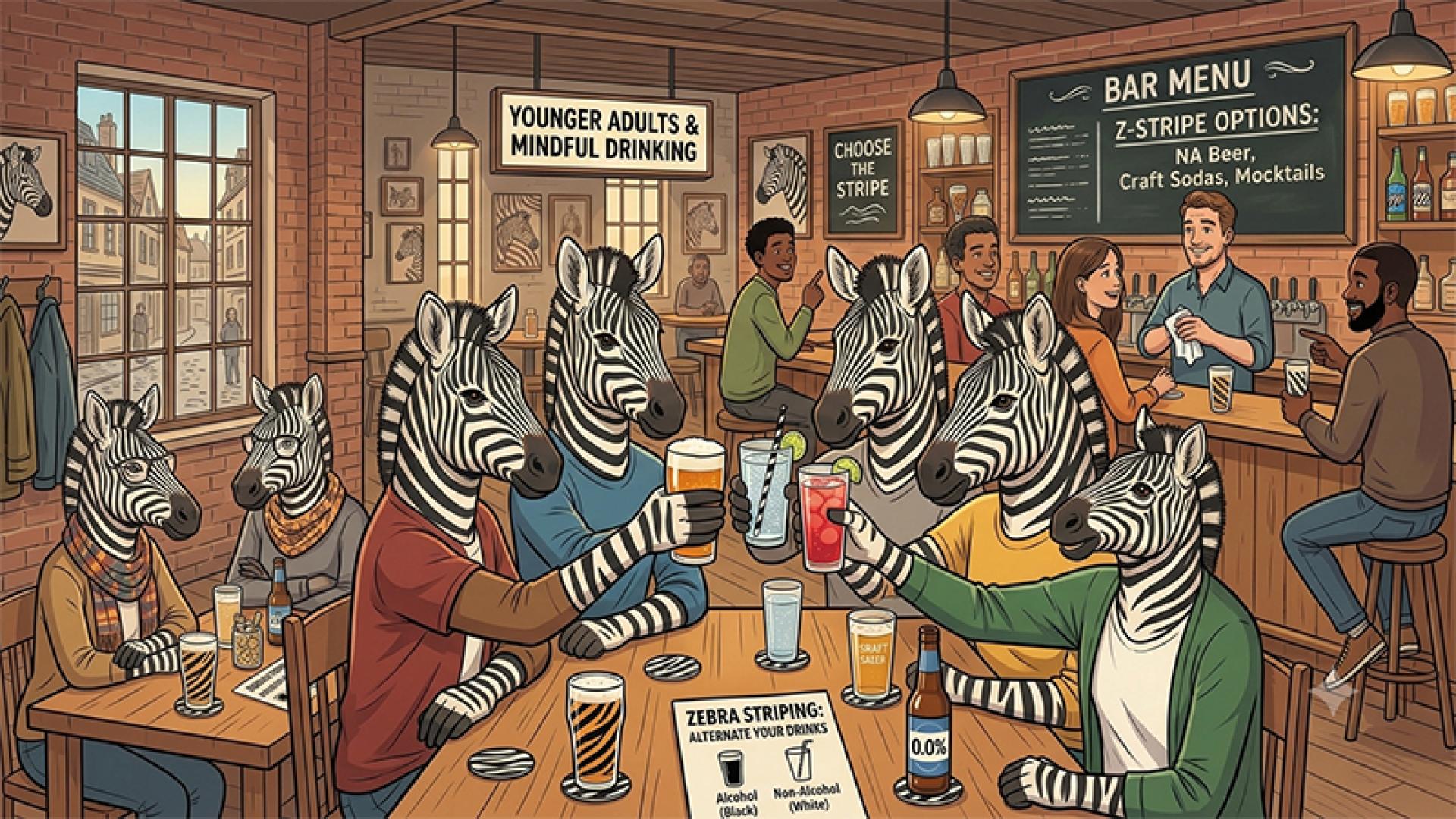
A growing number of younger legal-age consumers are “zebra striping,” alternating between alcoholic and non-alcoholic beverages during the same occasion. The trend is fueled by wellness culture, changing social norms, and an explosion of premium zero-proof options that increasingly blur the line between traditional alcohol and functional beverages.
What started as a niche movement has become a strategic challenge for CPG beverage brands, distributors, and retailers, who are now scrambling to rethink shelf space, assortment strategies, and portfolio positioning.
“The category is once again reshaping and shifting toward more selective, intentional, and occasion-led drinking,” Zach Poelma, senior vice president of commercial intelligence at beverage distributor Southern Glazer’s Wine & Spirits (SGWS), told CPGMatters.
The rise of zebra striping reflects a broader moderation movement that has accelerated alongside the “sober-curious” trend. Industry data suggests this is not fringe behavior.
“[Nearly half] of on-premise visitors already engage in zebra-striping,” said Kaleigh Theriault, beverage alcohol thought leader at NielsenIQ. “What’s particularly revealing is that 93% of consumers purchasing non-alcoholic beer, wine, and spirits are also buying traditional alcoholic products, confirming that these aren’t separate consumer bases, but the same shoppers making occasion-based choices.”
Of 22 adult beverage categories tracked by NielsenIQ, 17 have declined in velocity in the latest 52 weeks vs year ago.
The only 5 that are growing are the 3 non-alcoholic segments: Beer (+8.8%), Spirits (+15.8%), and Wine (+13.3%), Wine based cocktails, and Spirits based cocktails.
Source: NIQ RMS | US ALC Integrated Database | Latest 52 weeks 05/09/26
According to research firm Circana, non-alcoholic beer, wine, and spirits are increasingly complementing traditional alcohol purchases rather than fully replacing them. Circana officials noted that consumers have historically alternated alcoholic and non-alcoholic beverages. Still, today’s consumers have access to flavor-forward, premium options and sophisticated mocktails that make moderation feel less like a compromise.
The trend appears especially pronounced among younger adults.
“Zebra striping has become increasingly popular, and part of the broader moderation shift,” SGWS’ Poelma said. “Consumers are expanding their repertoire to include alternative beverages, rather than replacing alcohol outright.”
That overlap is critical for brands because it signals that the same consumer may purchase both full-proof and zero-proof beverages depending on the occasion.
When zero-proof takes space, something has to go
The biggest implication for CPG companies may not be consumption itself, but what moderation means for shelf space.
Retailers and distributors cannot continuously expand beverage aisles or cooler sets. As non-alcoholic products gain traction, another category must lose space.
“Retailers are actively allocating shelf space to no- and low-alc beverages as the category continues to expand,” Poelma said.
That expansion is already measurable at retail. According to data provided to CPGMatters by Circana, convenience stores now account for 8% of non-alcoholic beer, wine, and spirits dollar sales in Total U.S. MULO+ (multi outlet sales) including C-stores, are up 1.2 percentage points from three years ago. Grocery remains the dominant channel, accounting for 68% of sales.
The growing convenience-store presence is particularly notable because it signals that zero-proof products are moving beyond specialty wellness occasions into impulse and on-the-go consumption.
Circana said the channel’s growth suggests these products increasingly fulfill on-the-go occasions. Retailers are also rewarding products that offer clear functional or emotional benefits.
Circana officials pointed to the growth of probiotic sodas, adaptogenic beverages, hemp/CBD drinks, and products with cocktail-style flavor profiles as examples of beverages winning shelf space through targeted positioning rather than broad wellness messaging.
As no- and low-alcohol beverages grow, several traditional alcohol categories are losing momentum.
Circana data shows reduced velocity across still and sparkling wine, while craft beer and spirits seltzers have softened as well.
Additional NielsenIQ data paints a similar picture. Of 22 alcohol categories tracked, 17 declined in velocity in the latest 52 weeks versus the prior year. The only growing categories included non-alcoholic beer, spirits, wine, and cocktail-related segments.
The good news: Zebra striping doesn’t necessarily cannibalize sales of alcoholic beverages. Nielsen officials say buyers are shifting their spend from traditional alcoholic options to non-alcoholic options. On some occasions, non-alcoholic products can be incremental to a brand or category: where a consumer may once have opted for a soda or water, they’re now reaching for a non-alcoholic beer, wine, spirits, or cocktail option. Note that this varies by occasion.
Poelma said the pressure extends across most legacy alcohol segments.
“Across legacy alcohol categories, beer, wine, and spirits, performance remains broadly under pressure,” SGWS’ Poelma said. According to Poelma, still wine, flavored malt beverages, cider, seltzers, and cognac are all experiencing notable velocity declines.
Meanwhile, Sly Cosmopoulos, director of beverage marketing at Republic National Distributing Company, said high-proof spirits may also face increasing pressure as consumers shift away from “quick buzz” occasions.
“Consumers are shifting away from quick-intensity consumption and going toward experiences that emphasize flavor, setting, and social connection,” Cosmopoulos noted in an interview with CPGMatters.
Rather than treating non-alcoholic beverages as a separate category, many distributors and retailers are now building what Poelma described as an “ABV-spectrum strategy.”
That means portfolios increasingly need to accommodate consumers seeking full-strength, low-ABV, and zero-proof products within the same shopping trip or social occasion.
“Moderation behaviors like zebra striping are shaping how consumers drink and socialize,” Poelma said. “Suppliers, distributors and retailers now need to meet demand across the low-, mid-, and high-ABV spectrum.”
Who wins and who gets squeezed out
As assortment pressure intensifies, beverage companies may face a simple reality: products without a strong consumer proposition could disappear.
“Products without a clear value proposition are at risk of being squeezed out,” said Cara Piotrowski, senior director for Circana. “If they do not meet a specific need or occasion for the consumer, then there is a risk of reduced velocity and eventually being delisted.”
That creates both opportunity and risk for CPG beverage brands.
Companies that can tie products to moderation, wellness, flavor innovation, or occasion-based consumption may gain placement. Brands relying solely on legacy loyalty or undifferentiated positioning may struggle.
“Brands win shelf space by proving the consumer will buy their product,” Cosmopoulos said. “Marketing is key in getting the word out.”
For beverage executives, zebra striping is no longer simply a social trend. It is increasingly becoming a category-management issue that could reshape how the adult beverage aisle is merchandised, marketed, and monetized over the next several years.