How Far Should You Trust Your Next Tech Innovation? This Knowledge Framework Can Help
BRAND MARKETERS rely on information technology in nearly every planning, decision making and execution function. Data is gathered. Answers are pursued. Plans are conceived. Actions are initiated. Outcomes are evaluated.
It would be comforting to know with assurance which solutions can truly advance CPG business goals, versus merely sustaining entrenched, questionable or outdated business practices. From our interactions with industry professionals, we believe such assurance is in short supply.
Every new tech adoption decision (indeed every business practice adoption!) comes down to two fundamental questions:
- Is this solution sufficiently ready for us to put into practice?
- How ready are we as CPG product marketers to adopt and benefit from it?
For a technology to claim superiority or even efficacy, its provider must present credible claims of its capabilities. Prospective users must also assess their own readiness to put it to beneficial use.
These assessments are hard. New solutions may incorporate technologies that seem exotic at first. “AI inside every decision” is probably the most pervasive current example. Category Management, retail media and in-store sensing solutions are all focal areas right now. A few years ago, it might have been “big data” or “digital transformation.”
It’s not them, it’s us
Adopting new tech solutions may require re-framing the very business practices they are intended to improve. The decisions are multi-dimensional and the consequences are enduring. A poorly considered choice can take years to unwind. An impeccable choice can provide a significant competitive advantage.
At CPGMatters, we are determined to use our editorial platform to help inform readers who face these decisions every day. To do so, we’ve partnered with tech visionary Georges Mirza, principal of Comtask, who has been a regular contributor of thought leadership for our publication since its relaunch last March.
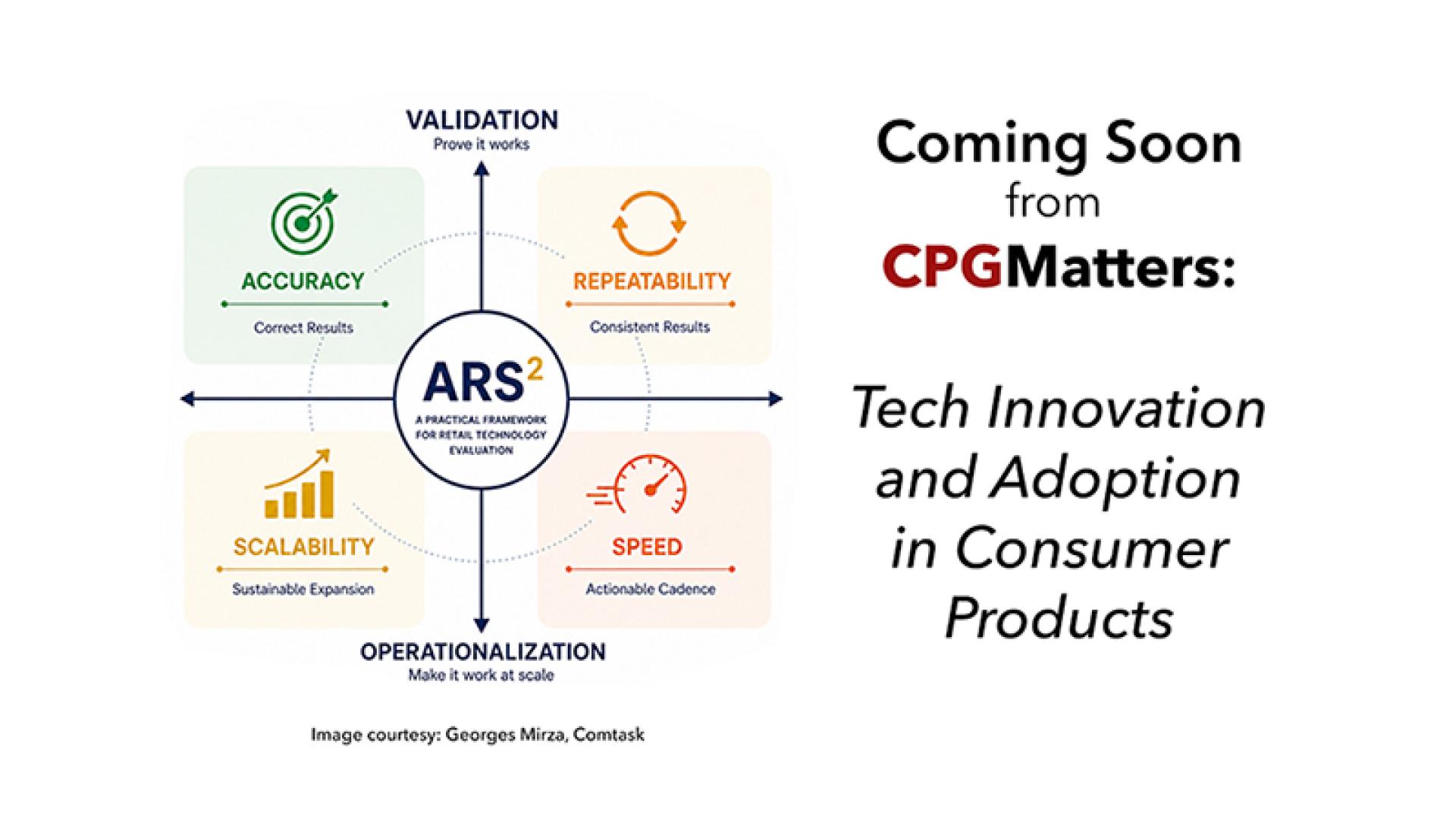
Mirza has developed an elegant and practical framework through which decision makers can compare and valuate not only their tech adoption options, but also their own state of readiness to make changes in their business practices. He calls this framework ARS²:
- Accuracy. Does the system produce correct and usable results under real-world conditions, including edge cases and variability?
- Repeatability. Can performance be consistently reproduced over time, across stores, and through operational changes?
- Scalability. Does performance, cost, and operational burden hold as footprint, assortment, and complexity increase?
- Speed. How quickly can insights be generated and acted on at the cadence required for the use case?
With his expert guidance, CPGMatters is incorporating ARS² as a “lens” and enhancement for some of our planned technology coverage in the months ahead. Our intent is to provide a type of service journalism that is not obtainable elsewhere – a way to shed light on the impact of tech trends and the companies who put them to use.
Insights-driven agenda
In coming months we’ll be covering some of the most pervasive technology trends and developments that impact consumer brands. We’ll employ ARS² to examine the state of readiness for various fast-moving solution categories, with the goal of exposing insights and debunking hype.
CPGMatters will not rate solutions or arrange them into competitive “quadrants” in the manner of some well-known consultancies. As Georges Mirza says, “ARS² is designed to create transparency and shared understanding – not rankings or competitive scoring.”
We will talk to tech visionaries and power users about their business practices and present their perspectives. Consumer brand companies are grappling with tech innovation on many fronts. Here’s a top 10 list of the solution categories on our initial agenda:
- Retail Media buying/audience/measurement
- Inventory accuracy and reordering
- Robotics for in-store sensing
- Electronic shelf labels
- AI-enabled Category Management
- Merchandising implementation
- Influencer marketing platforms
- Unstructured data sources for trend forecasting
- New product development and launch
- Trade promotion management
Where available we’ll incorporate reference documents and case studies. Readers and solution providers are invited to contact us to suggest topics: editor@cpgmatters.com
Over time we hope to reveal which solutions are accurate, repeatable, scalable, and swift enough to matter in today’s business environment.