Retool Your Global Supply Chain for an Era of Disruption
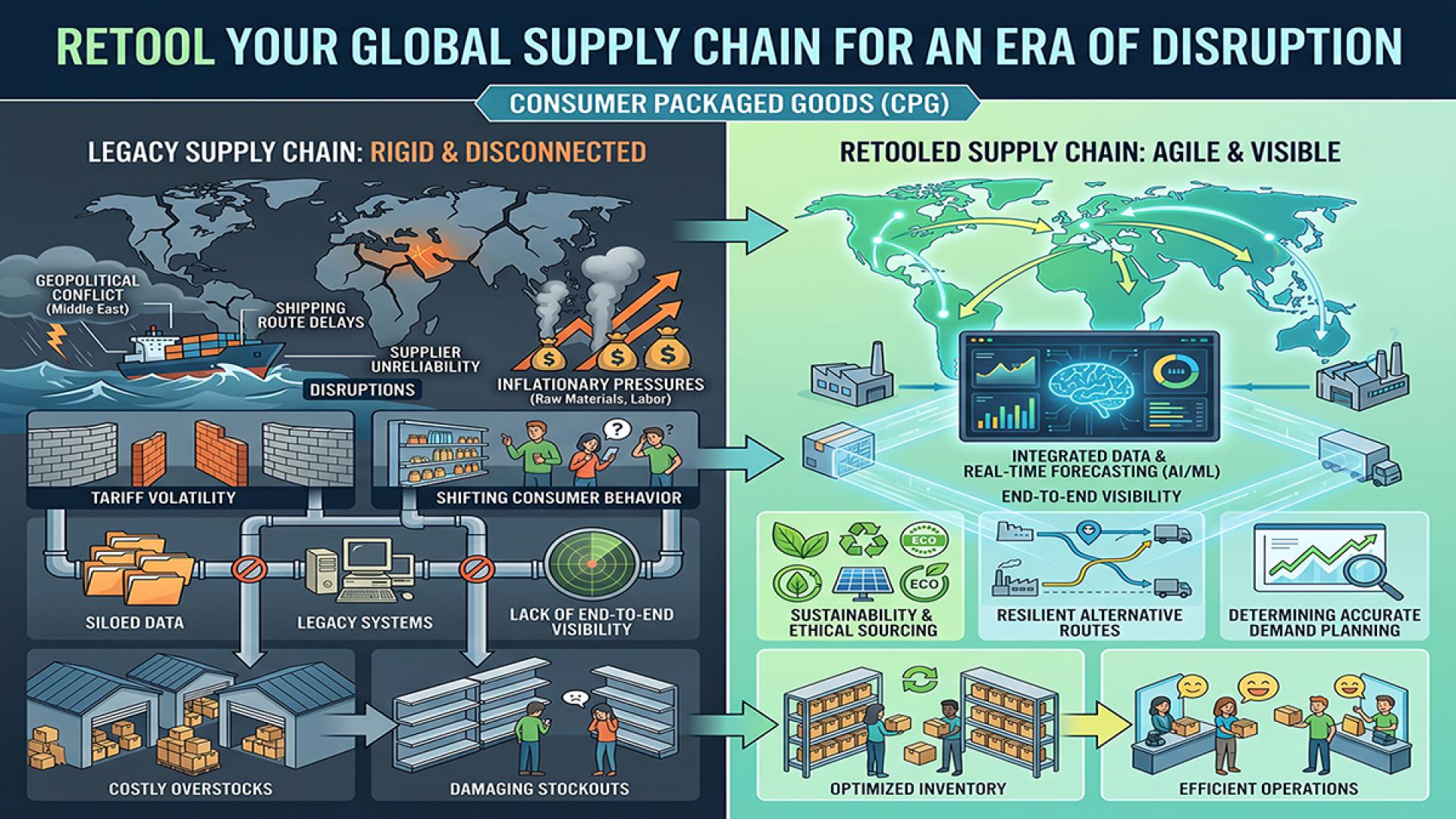
THE GLOBAL SUPPLY CHAIN for Consumer Packaged Goods is operating under unprecedented strain. While acute geopolitical events—such as the ongoing conflict in the Middle East and its profound impact on global shipping routes and supplier reliability—command immediate attention, they are just one layer of a highly complex landscape.
Today’s CPG supply chain leaders are battling a confluence of systemic challenges: stubborn inflationary pressures on raw materials and labor, tariff volatility, rapid shifts in consumer purchasing behavior, and intensifying demands for sustainable, ethically sourced operations. Compounding these hurdles is a pervasive lack of end-to-end visibility.
Too many organizations still rely on siloed data and legacy systems that make accurate, real-time demand forecasting and supply planning nearly impossible, inevitably leading to costly overstocks or damaging stockouts.
In an environment where extreme weather, port congestion, and sudden economic shocks are the norm rather than the exception, traditional, cycle-based planning simply cannot keep pace. Retooling your global supply chain is no longer just a strategic initiative—it is an operational imperative.
Here are three critical steps to building a synchronized, self-healing supply chain capable of withstanding today’s profound volatility.
Step 1: Put People First
Technology is only as effective as the people orchestrating it. A successful transformation requires recognizing that people are the key to unlocking new capabilities. Beiersdorf, a global leader in skin care with 20,000 employees in over 170 affiliates worldwide and best known for brands such as NIVEA and Eucerin, recently completed an evolution of their supply chain systems. The investment has allowed planners to better cooperate in matching end-to-end supply and demand while organizing Beiersdorf's increasingly frequent product innovations.
A key pillar of the company’s supply chain upgrade is the idea that you must first build organizational design around your talent:
- Take Down Organizational Walls: Transition away from fragmented, localized teams that suffer from poor knowledge retention. Establishing Centers of Excellence (COEs) allows you to pool knowledge, create clear career paths, and establish true end-to-end (E2E) ownership across the network.
- Balance Training and Recruiting: Capability building must focus equally on upskilling your current workforce and recruiting new talent equipped for an AI-driven environment.
- Pace the Change: Do not try to optimize everything at once. Focus on building a stable global template first, and remember that local perception often defines the overall success of the project.
Step 2: Follow a Structured Deployment Approach
Deploying a new Advanced Planning System (APS) requires methodical execution. Mark Trainor, Sr. Director Global Planning Transformation Technology at AstraZeneca, one of the largest global biopharmaceutical businesses, maintains a proven seven-step framework to ensure seamless integration:
- Change Impact Assessment: Clearly define the differences between your "As-Is" and "To-Be" states, assessing the direct impact on people, processes, and systems.
- Data Preparation: Identify and configure the necessary data parameters, clearly defining the assets and resources to be planned across specific time horizons.
- Education & Training: Equip your users with the necessary skills and knowledge to support testing and fully adopt new ways of working.
- Testing: Rigorously test and fine-tune both the system and the workflows prior to full implementation.
- Cutover & Go-Live: Establish the production environment and officially deploy the process and system changes.
- Hypercare: Provide intensive, post-go-live support to resolve issues swiftly and ensure a smooth transition to the business.
- Wave Closure & Handover: Formally transition from a project state to business-as-usual operations, driving long-term adoption and benefit realization.
Step 3: Implement an Intelligent Decision-Centric Planning System
To survive sudden shocks—like tariffs and the current Middle East crisis—your supply chain needs the agility to pivot instantly. This requires moving away from static, process-driven planning cycles and embracing decision-centric planning—a dynamic approach that continuously senses changes, evaluates trade-offs, and quantifies business impact in real time.
This methodology accelerates your "decision velocity" by combining human expertise with AI.
- Harness Autonomous Agents and AI: By utilizing AI assistants and event-driven agents, routine manual tasks are automated, and supply chain signals are monitored continuously. This frees your planners to focus on what matters most: cross-functional collaboration and strategic human validation.
- Real-Time Scenario Modeling: When a disruption hits—whether it's a closed shipping lane or a sudden spike in raw material costs—organizations can instantly run hundreds of simulations. This allows planners to proactively anticipate risks, optimize outcomes, and execute the most profitable response rather than resorting to reactive firefighting.
- End-to-End Synchronization: The system must support customer centricity and rapid response through comprehensive operational planning, finite scheduling, and unified Sales & Operations Planning (S&OP).
The Payoff: Real Value in Volatile Times
When these steps are executed correctly, the results deliver tremendous competitive advantages. By example, with OMP’s Unison Planning, AstraZeneca achieved record service levels of 99.8% stock availability, reduced inventory days cover despite massive sales growth, and drastically lowered their expedite costs after scaling their advanced planning solutions and embracing a structured transformation.
In today’s climate, the question is not if another major disruption will occur, but whether your supply chain decision-making is agile enough to turn that uncertainty into an advantage.
About the Author
With more than three decades of experience in B2B and supply chain technology marketing, Lisa Henriott leads commercial marketing strategy for OMP, a global leader in supply chain planning. Before joining OMP, Lisa held senior marketing roles at Logility, Manugistics, and others, and spent years advising C-level executives at early-stage technology companies. She also serves as Entrepreneur in Residence at Kennesaw State University, mentoring tech leaders and supporting the next generation of innovators.