Unilever’s Portfolio Strategy is a ‘Diet for Wellbeing’: Solheim
Report from Groceryshop 2026: Wellbeing is at the forefront of corporate strategy for Unilever, as it embraces OTC supplements, remedies and healthy beauty.
THERE’S A METHOD BEHIND the transformation of Unilever’s food and beverages footprint over the past three years. It centers on wellbeing – of consumers and the company’s portfolio value.
The €50.5 billion global consumer goods company has redirected much of its capital into prestige beauty, digital-first wellness, and clean skincare, categories seen as higher-margin and higher growth.
Newly gone are its well-known frozen desserts brands, including Breyers and Ben & Jerry’s, which were spun off in 2025 as The Magnum Ice Cream company. In a series of other de-diversifications since 2021 it had sold or spun-off numerous stalwarts of the center store, including Lipton, TAZO, Q-Tip, Suave and Caresse.
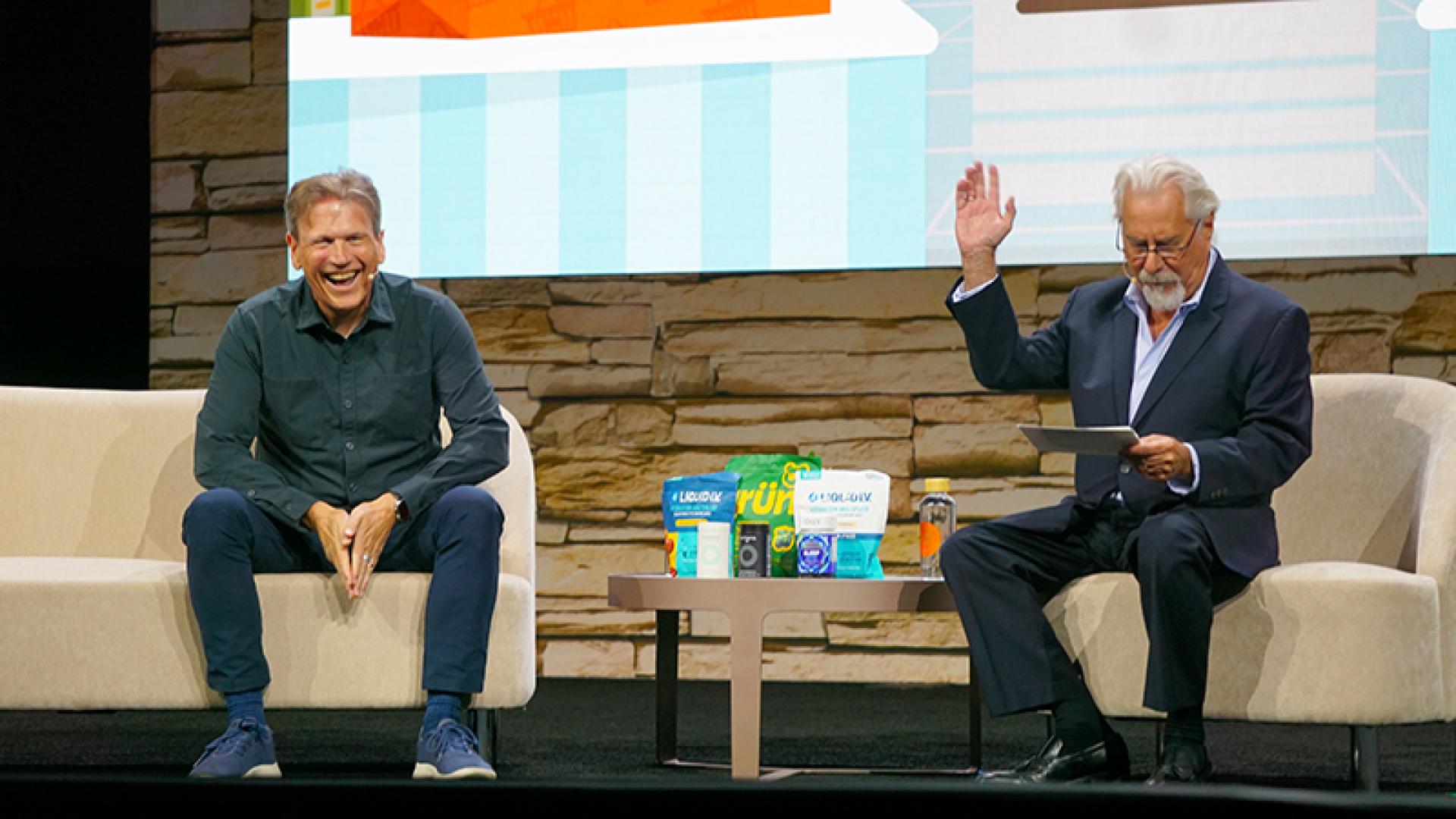
At the recent Groceryshop in Las Vegas, Jostein Solheim, CEO of the Unilever Wellbeing business unit, sat for a 20-minute keynote interview in which he unpacked some of the reasoning behind his division’s recent brand acquisitions and product focus.
Industry journalist and personality Phil Lempert, aka “The Supermarket Guru,” was the interviewer.
Much of their discussion centered around the attributes of four acquired product lines that were displayed on stage: OLLY Nutrition dietary supplements were added in 2019. Liquid IV hydration drink mix joined the portfolio in 2020. It acquired majority ownership of Nutrafol hair regrowth formula in 2022. In June of this year it acquired Grüns, another nutritional supplement brand.
All four of these brands came with strong direct-to-consumer heritage. All have been recently prominent in media advertising and promotion campaigns and influencer marketing on digital channels thanks in part to Unilever’s capital strength. For all four, the tone of their messaging emphasizes science-supported health benefits.
Three shifts inform Unilever’s strategy
Solheim addressed the reasoning behind the company’s pivot away from traditional CPG brands and toward lifestyle products.
“We saw three really big shifts,” he said. “The first shift was health as the absence of disease was replaced by health as a lifestyle.”
He said Unilever has observed more people “taking agency” over their own health and making that integrates into their everyday life. That offered an opportunity for branding and building deeper relationships.
“The second big shift was the convergence or blurring of beauty and well-being. Nine out of ten see this as one thing, and 86% of consumers say you can’t feel beautiful if you're not feeling good inside,” he added.
“Then of course, the third shift was the digitalization of everything.”
Notably, sales of the four power brands at the center of Unilever Wellbeing are “about 50-50 online and in store,” he said.
That statistic is a significant departure from Unilever’s heritage brands, which were distributed almost entirely through retail partners. The ice cream brands, in particular did not lend themselves to DTC delivery.
Lempert pressed the point with a question: “So strategically, Unilever was one of the biggest food companies in the world. And now you're telling me, ‘don't view us as a food company?’”
“Think of us as a wellness beauty company. That is really two shifts coming together,” Solheim replied. “When you go back 10 years, beauty was very much defined as appearance. It's been a torture.”
“He continued, “When you then combine that with health as a lifestyle, and you look at things like GLP-1s, this is the ultimate proactive take charge of your own health. Of course it has implications for food, but it has a lot of other implications for your nutrient needs.”
Consumers’ embrace of the weight loss medications is a “huge tailwind” that is leading people to think differently about their nutritional needs, he said.
Scientifically supported solutions
Unilever announced last Spring that it is constructing a new $270 million North America Global Innovation Centre near New Haven, Connecticut. Set to open in 2029, the facility adds R&D capabilities linking science, technology, and culture “to create breakthrough products across personal care, beauty and wellbeing brands.”
Lempert prodded Solheim to justify this commitment and also address latent skepticism regarding supplement products:
“This is an excellent point. This has been an industry with some over-claiming, if we're really honest. One of our missions is to bring science and clinical proof points to the heart of this industry and our brand.”
Solheim elaborated that in 2025, Unilever Wellbeing conducted 17 clinical studies to support its product claims.
“For our product Nutrafol, which is a holistic approach to hair health, we have done three gold standard, placebo, double-blind clinical studies. We have tested this on women, pre-menopause, perimenopause, menopause, post-menopause. It's a potent product. And we have about 26 publications.”
He added, “Now, the exciting thing is, the beauty of the large language models is they are making this information accessible to consumers. They can research, assess what they're looking for, and get the right information that they need from a clinical point of view. And that's exciting.”
TV ads meet influencer marketing
Lempert noted that television advertising and promotion for Nutrafol have particularly active of late. That includes a highly visible promotion program with Major League Baseball now in its second season. He asked Solheim to elaborate on his company’s ad strategy.
“Every time somebody says something is dead – TV is dead – boom, it's back,” Solheim said. “I believe in balancing the three elements of the triangle. It is what you say, your marketing, your communication.”
He observed how the AI LLMs can enable consumers to access Unilever’s science, its credibility, and its clinical studies. “We need to make that accessible.”
Then possibly echoing published statements from Unilever CEO Fernando Fernandez that the company has shifted heavy marketing spend to thousands of influencers, he added, “Of course, it’s a lot about what other people say. Influencers and content creators can be challenging in a world of claims and overclaiming. So you have to take a responsible approach to it.”
Solheim continued, “We have 7,500 dermatologists in our network who prescribe and recommend Nutrafol to their patients. I think that's a sort of a backbone of credibility and trust building.”
Need-driven Zoomers take agency
Solheim insists the whole well-being industry is driven by Gen Zs, who have eclipsed the Millennials cohort and are disproportionately engaging, investing, and "thankfully educating the elders."
He said, "We do see, of course, a shift throughout generations. But the reason we are so bullish on well-being at the core, also of beauty and personal care, is this fundamental trend driven by young people who are engaging early.
"I'm just so excited to see how consumers are increasingly going after what they need. They're not looking at categories, they're looking at their needs. They're able to find and research and get the power to take agency over their own health."
Stores’ essential role in the digital shopping journey
Is Solheim comfortable that today nearly half of the sales for Unilever Wellness are digital?
“Absolutely. I think the whole shopping journey has been digitalized. I don't think anybody's going to buy a $30, $20 product in retail and not research that. It’s connected to their online shopping experience.”
He added, “Still, more than 50% prefer to discover it in physical retail. So again, TV's dead. TV's back. The store doesn't matter. The store matters. How we fuse it together obviously evolves. But people are online, in store, and living in that whole funnel. It is real and you have to tackle it in real time.”
How AI opens doors
Like most consumer goods companies these days, Unilever Wellbeing is embracing AI tools for product innovation. Solheim said it enables his team to run scenarios and identify new ingredients and potency at a whole new speed.
“We can do 10 years in a year now in terms of science. So that is a big focus for us. We believe there are so many more opportunities to come up with highly efficacious products that address these really important needs.”
“So how we innovate within our portfolio to really drive that is a top priority. Innovating, going deeper on the science that’s a big part of it. Is there room for other companies in our family? Sure, but you should ask my boss.”