Shortage of Packaging Materials Portend Future Shock
A SHORTAGE of packaging products and materials is a key challenge facing the industry in the future, according to a survey of senior industry leaders of global brands.
The poll was conducted by packaging sustainability consultancy Aura at the SPC Advance 2025 event in Boston. It found that three-quarters (75%) see these shortages as the primary issue for the packaging industry in the future.
Gillian Garside-Wight, director of consulting at Aura, said, “Resource scarcity is a growing concern for the packaging sector and industry professionals are right to be worried. Access to daily essentials and critical materials like water, food, fiber and fossil-fuel derived polymers are likely to be severely constrained in years to come.
“The world could see a shift towards brands and retailers using the materials that are the most readily available, rather than those that are the most suitable for a particular product,” he said.
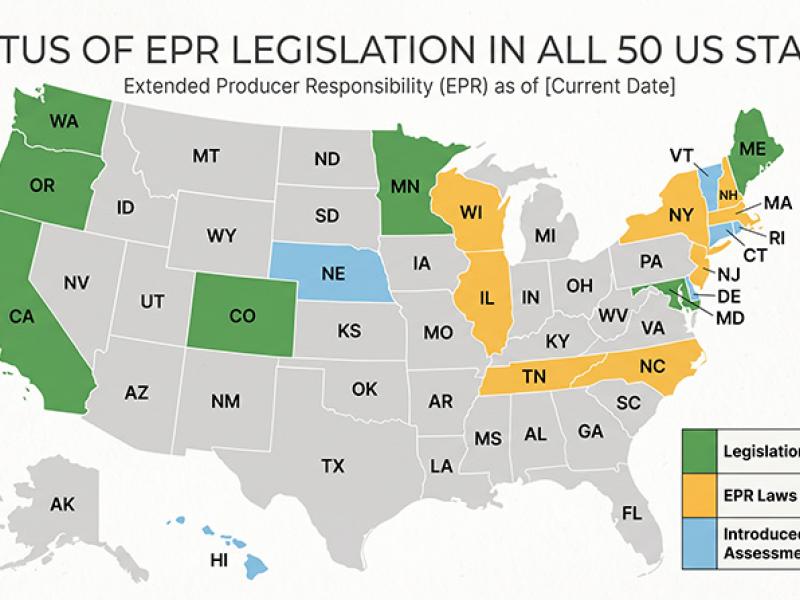
In the near term, the biggest impact for brands selling in the U.S. will likely be for California, which had its SB 54 EPR reporting deadline on November 15, 2025, according to the consultant.
“The coming 12 months will see the ripples of that deadline continuing to impact brands and retailers globally. It will be devastating for many who sell in the state with the world's fifth-largest economy, who will find themselves potentially facing significant fees as well as significant fines for non-compliance of up to $50,000 per day,” he said.
October 2026 is when California's Truth in Labelling legislation comes into force, he pointed out.
“Brands and retailers will have to expect litigation from then on if their packaging says it’s recyclable when it is not, or if it's misleading. Businesses are going to need to ensure they have 100% accurate data on every component that makes up their packaging, or else the financial penalties are going to leave them reeling. That data will also be the only way to ensure that their packaging is meeting consumer demands for greater recyclability and sustainability,” he said.
When polled executives at SPC Advance were asked about the main potential opportunities for the future of sustainable packaging, more than nine out of ten (92%) cited innovation in materials in the years to 2050, followed by dynamic recycling infrastructures (78%) and advances in AI and digital technologies (72%).
Garside-Wight said, “Material shortages, the lack of climate change and emission data, and geopolitical trade issues will be compounded by regulations like EPR becoming ever more stringent. Brands and retailers are heading into a perfect storm with no clear vision of what the coming years to 2050 will hold.
“What’s evident is that future brand success comes from laying the groundwork now and we’ve seen that many businesses are investing their time and efforts now to secure a successful future. This means tracking real-time data on granular packaging specifications, accurately calculating carbon emissions and circular solutions, plus availability of raw materials including recyclate,” he said.
Global resource scarcity is one of four potential futures highlighted by Aura’s Future Packaging Scenarios report, a study into the key factors that are likely to impact packaging needs and demands in the coming decades. The other three scenarios focus on an evolution of today’s challenges, a high-tech future, and a pushback against technology.
The report explores how access to everyday items and critical materials like water, food, fiber, and fossil-fuel derived polymers could be severely constrained, forcing manufacturers to turn to locally sourced, low-cost materials and even to mine landfills for waste to repurpose.