Innovation Meets RGM: CPG Rebalances its Go-To-Market Model
PRODUCT INNOVATION has been the principal fuel for growth in the consumer-packaged goods industry over the past 50 years.
Manufacturers introduced new brands, formulations, flavors, formats, benefits, and usage occasions. Marketing built awareness. Retailers expanded distribution. Consumers rewarded differentiated value with increased household penetration and volume growth. Revenue was largely the outcome of creating products consumers genuinely wanted.
That growth model has fundamentally changed.
Today, manufacturers operate in an environment characterized by slower category growth, retailer concentration, private-brand maturity, rising costs, fragmented channels, and consumers who scrutinize every purchase.
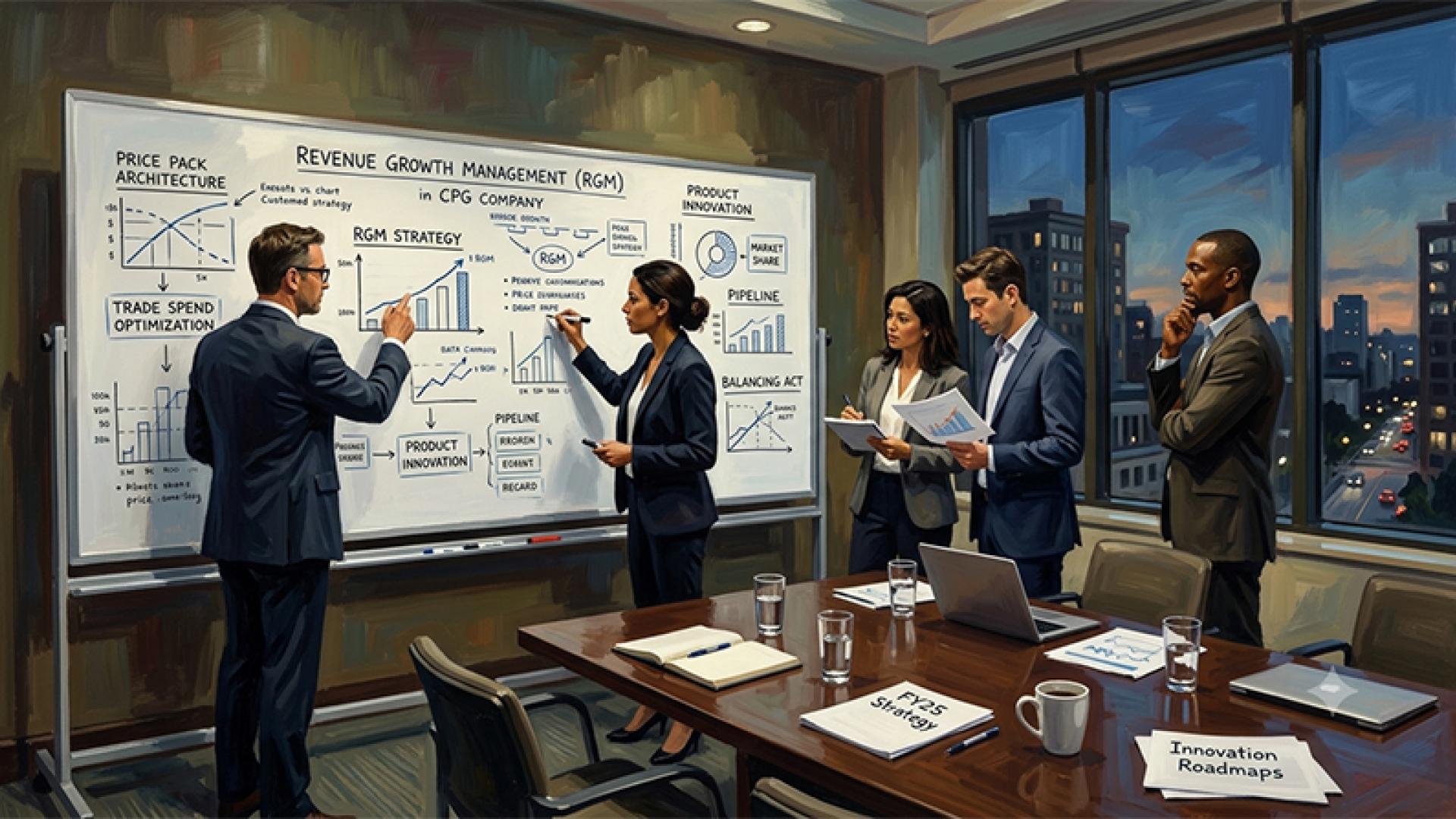
In response, many organizations have shifted their centers of gravity from innovation-led growth to Revenue Growth Management (RGM) — where they optimize pricing, promotions, trade investment, assortment, pack architecture, and customer economics to improve profitability.
The shift has been both necessary and successful. Revenue Growth Management has become one of the industry's most valuable commercial capabilities. It has improved pricing discipline, strengthened trade investment decisions, optimized price-pack architecture, and enabled organizations to recover inflationary costs while protecting margins.
However, a new strategic challenge is emerging
As organizations become more proficient at engineering revenue from existing portfolios, many invest proportionately less to create the next generation of consumer value. Revenue management has evolved from an enabling capability into the dominant commercial lens through which many investment decisions are evaluated.
The consequence is subtle but significant. Innovation asks a fundamentally different question than revenue management.
- Innovation asks: How do we create new consumer value?
- Revenue management asks: How do we capture more value from what already exists?
Both disciplines are essential. Neither is sufficient by itself. Organizations that overweight revenue management risk optimizing today's business while gradually weakening tomorrow's competitive advantage.
Best emerging practice: Build an integrated growth system
Leading CPG organizations are rethinking the traditional isolation of product innovation from RGM. Instead, they are creating integrated commercial growth organizations in which both capabilities operate under a shared agenda.
Several best practices are beginning to distinguish market leaders.
- Govern growth through an Executive Growth Council. Rather than allow Innovation, Marketing, Sales, Finance, Category Management, and Revenue Growth Management to operate independently, leading organizations establish an enterprise commercial council to balance short-term financial performance with long-term demand creation. Its charter is simple: Optimize today's earnings while creating tomorrow's growth.
- Bring revenue management into innovation earlier. Historically, Revenue Growth Management evaluated products after development. Best-in-class organizations reverse that sequence. Pricing architecture, willingness-to-pay analysis, elasticity modeling, pack-size optimization, channel economics, retailer profitability, and trade implications are incorporated during concept development—not after commercialization. Innovation becomes commercially engineered before launch.
- Build consumer insight into revenue decisions. Revenue Growth Management should no longer rely solely on financial models. The strongest organizations continuously integrate shopper research, household behavior, retail execution data, AI-enabled consumer feedback, category dynamics and competitive intelligence. The objective shifts from optimizing spreadsheets to optimizing consumer value.
- Measure growth, not functional success. Traditional KPIs often create conflicting incentives. Innovation measures launches. Revenue management measures margin. Sales measures volume. Marketing measures awareness. Supply chain measures cost. Leading organizations instead adopt enterprise growth metrics. These include: profitable household penetration, incremental category growth, consumer lifetime value (CLV), innovation productivity, revenue realization, trade ROI, customer profitability, share growth, and long-term brand equity. Growth is a shared enterprise outcome. No function succeeds unless the business succeeds, and no function is insulated from the consequences when it does not.
- Develop cross-functional commercial talent. Tomorrow's commercial leaders will not be specialists. They will understand consumer behavior, pricing sciences, innovation, retail strategy, AI-enabled analytics, financial management, and category development. Organizations increasingly rotate talent across marketing, innovation, revenue management, sales, finance, category leadership, and shopper insights to build integrated commercial capability.
- Replace annual planning with continuous commercial adaptation. The traditional annual planning cycle is becoming obsolete. Leading organizations operate through continuous commercial learning, focusing on understanding consumer demand, price elasticity, retail execution, competitive actions, trade effectiveness, and innovation performance. These are monitored continuously and adjusted in near real time. Revenue management becomes adaptive rather than reactive.
- Balance value creation with value capture. Perhaps the most important best practice is philosophical. Revenue Growth Management should not become an exercise in extracting more value from existing consumers. Its purpose should be to help your innovators create products that consumers willingly value more. One discipline creates demand. The other monetizes demand. The highest-performing organizations excel at both.
The next competitive advantage
The future will not belong to organizations with the largest innovation budgets. Nor will it belong to organizations with the most sophisticated Revenue Growth Management teams.
It will belong to companies that seamlessly integrate both capabilities under a single commercial operating model. The next generation of CPG leaders will use RGM techniques to identify where value can be created and invest in innovation to create it. They will use consumer insight to validate it, AI to accelerate learning, retailer collaboration to commercialize it, and continuous analytics to optimize it over time.
The competitive advantage of the next decade will not materialize by choosing between product innovation and revenue engineering. It will come from building an organization capable of continuously creating consumer value while capturing commercial value with equal discipline.
The winners will not simply engineer better revenues. They will engineer better growth.
Postscript: Case studies to consider
Several leading CPG companies offer useful examples, though each balances innovation and revenue growth management differently, rather than operating from a single universal model.
- PepsiCo is among the clearest examples of scaled revenue-management capability paired with active portfolio innovation. Its recent work on AI-supported pricing and promotion optimization illustrates the commercial discipline; its expansion into functional beverages, zero sugar, protein, and better-for-you platforms shows the demand-creation side. The lesson: use RGM to improve pricing and promotional decisions while placing larger bets on shifts in consumer need states.
- Mondelēz International is building a more integrated model around recipe, format, and product renovation. Its use of AI to accelerate formulation and testing—including work on gluten-free and reformulated products—demonstrates how innovation can simultaneously improve nutrition, sustainability, cost, and speed. The lesson: make innovation more commercially viable from inception, rather than asking RGM to repair economics after launch.
- Nestlé provides a portfolio-scale example. Its broad presence across nutrition, pet care, beverages, prepared foods, and health science gives it multiple innovation vectors. Its commercial agenda increasingly emphasizes volume recovery, pricing discipline, and portfolio prioritization. The lesson: balance pricing with renovation and category-specific innovation to protect both margins and household demand.
- Procter & Gamble remains a useful benchmark for linking product superiority to pricing power. Its model has long centered on product performance, brand investment, and disciplined price-pack architecture—helping defend premium positioning in categories where private label is increasingly credible. The lesson: RGM works best when it monetizes a clearly differentiated consumer proposition, not when it attempts to substitute for one.
- Unilever and L’Oréal illustrate the importance of connecting innovation speed, consumer insight, and commercial execution. Unilever has continued to invest in data, talent, and innovation as part of its broader future-readiness agenda. L’Oréal has used AI to accelerate product development and repurpose technology across categories. The lesson: faster learning cycles can make innovation more responsive while preserving commercial rigor.
The common denominator
The strongest organizations do not position innovation and RGM as competing agendas. They use RGM to identify where consumer value can be monetized, and innovation to create the differentiated value that makes growth durable.
 Thom Blischok serves as Chairman and CEO of The Dialogic Group, LLC, where he provides strategic guidance to leading retailers, technology innovators, consumer packaged goods companies, and investment firms specializing in retail transformation, artificial intelligence/robotics, operations, and consumer engagement