A Look Back at Beacons: How a Promising In-Store Marketing Tool Got Lost in the Aisle
BRAND MARKETERS’ DESIRE TO KNOW exactly how shoppers interact with their products on the physical shelf greatly intensified with the spread of digital retailing.
The visibility of online encounters was detailed, and the data was granular and complete. The brick and mortar store, by comparison, was a black box where shopper behaviors were a mystery.
Then a quirky hero emerged in 2013 with some fanfare made executives genuinely excited. That hero was Apple’s iBeacon, a small, low-power communications device that could be discreetly attached to retail displays. Now they had a way to retarget consumers in the store.
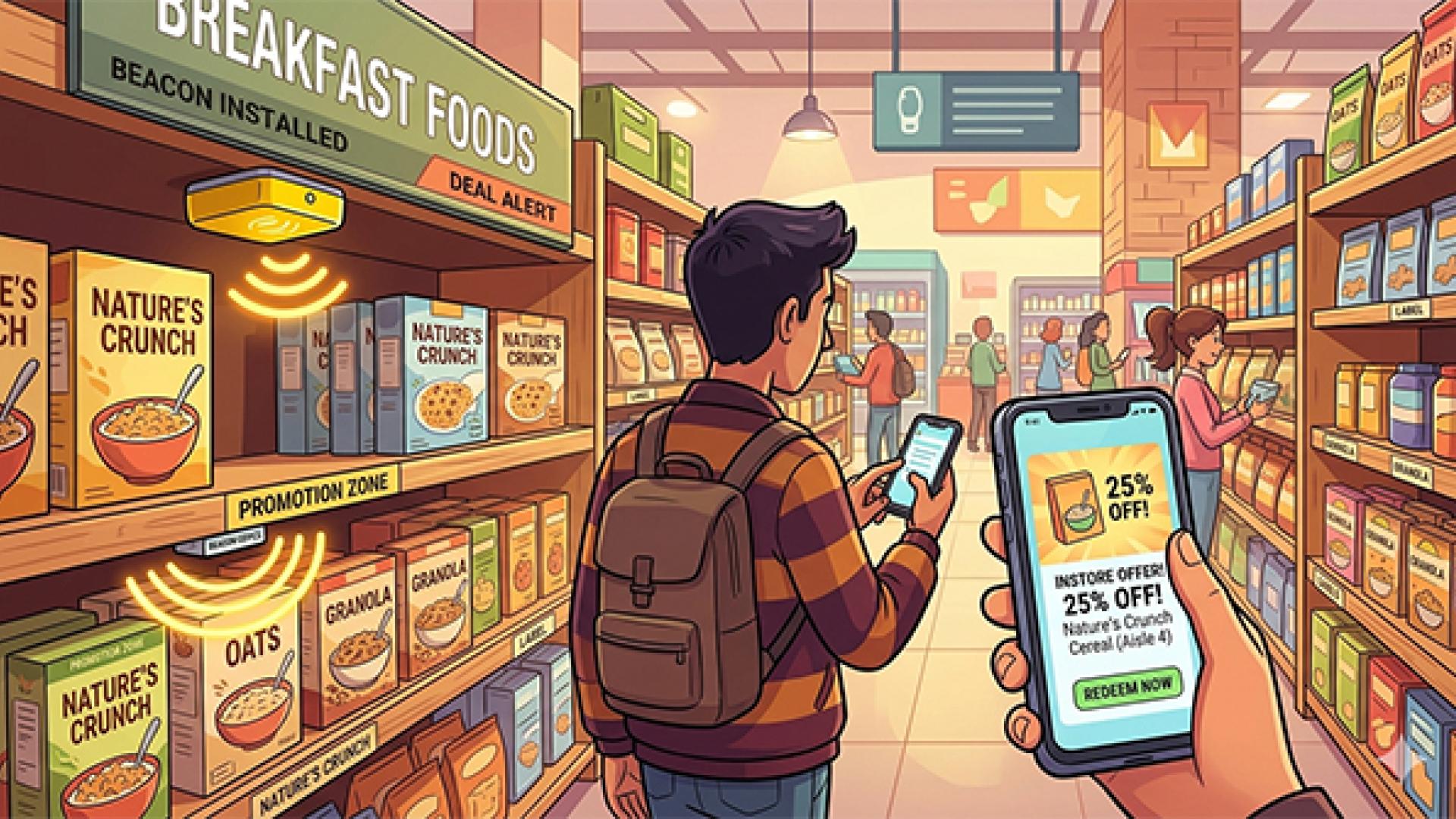
The puck-shaped units – about the size of a quarter – could scan for consumers’ digital phones as they passed in the aisle, gather data and relay messages and offers. Apple’s iBeacon, and imitators to follow, including Google’s Project Beacon, assured retailers this was a revolution in proximity marketing.
Beacons promised to compete with websites to create “in-store moments of truth” by pushing notifications and product recommendations to shoppers. Nearly one third of top 100 U.S. retailers had tested them by 2017.
Beacons went mostly dark at retail a few years later. The story of why is worth understanding.
A quick tech recap
Beacons are small, battery-powered wireless transmitters that use Bluetooth Low Energy (BLE) — a power-sipping variant of standard Bluetooth — to broadcast a short, repeating signal. That signal carries nothing more than a simple identifier, like a digital name tag.
When a shopper's smartphone came within range (typically 30 to 300 feet, depending on configuration), a compatible retail app on the phone would "hear" that signal and trigger an action: push a coupon, display a product recommendation, log foot traffic, or guide the customer toward a specific section of the store.
The underlying concept was elegant in its simplicity. GPS can tell you a customer is at a shopping mall or in a specific area. The local Wi-Fi can confirm they're in your store. The BLE beacon could tell you they were standing in front of the denim wall, hovering near the clearance rack, or lingering in the shoe section for four minutes.
That granularity — aisle-level location data — was something retailers and brands had never had before. Like having hundreds of salespeople monitoring customer behaviors and keeping diligent records.
Rush to implementation
The timing seemed inspired. Stores worried about losing sales to websites. Apple launched its iBeacon protocol in 2013 alongside iOS 7, instantly making the technology compatible with hundreds of millions of iPhones. More tech giants jumped in at their heels.
Google introduced its own competing standard, Eddystone, in 2015. A wave of startups rushed in to build the hardware and software infrastructure around them. On the hardware side, Estimote — a Polish-American startup that shipped elegant, sticker-sized beacons — became something of a darling, with its developer kits landing in the hands of thousands of retailers and experimenters.
Gimbal, originally spun out of Qualcomm's retail solutions division, offered beacons for as little as $5 to $30 apiece and built one of the more robust management platforms. Kontakt.io carved out a strong enterprise niche.
On the platform and marketing side, inMarket built a network reaching tens of millions of shoppers monthly, while Swirl Networks focused squarely on fashion retail. Facebook, not wanting to be left out, began distributing free BLE beacons to small businesses to power its "Place Tips" feature. Even Samsung, Cisco, and Hewlett Packard Enterprise eventually entered the space.
It seemed like destiny (what could go wrong?)
The pitch to brands and retailers was seductive: a customer walks past a display of running shoes, and within seconds, a push notification appears on their phone with a 15% discount on the exact brand they'd browsed online the day before.
The early retail adopters were aggressive. Macy's had deployed beacons nationally through a partnership with Shopkick. Target, Lord & Taylor, Urban Outfitters, American Eagle, Alex & Ani, Kenneth Cole, Sephora, and Timberland also ran deployments.
Major League Baseball wired up stadiums including Dodger Stadium, Petco Park, and Target Field in Minneapolis, using beacons to push seat upgrade offers and concession deals to fans' phones mid-game. Beacons were the new black.
Consumer marketers dove in too. Hillshire Brands ran what became the first major CPG beacon campaign in 2014. After a national iBeacon push for its American Craft Links sausage line through inMarket, it reported a 20-times increase in purchase intent, a result that made the rounds at every retail technology conference for years afterward.
McDonald's tested iBeacons in Columbus, Ohio. Coca-Cola partnered with Dollar General on a Halloween-themed beacon campaign. Heineken, Clorox, and Energizer all ran programs through inMarket’s network.
Early results were striking enough to fuel serious optimism. One inMarket study showed a 24% sales lift for beacon-promoted products during a Black Friday campaign. By 2015, nearly a third of the top 100 U.S. retailers had deployed at least some beacons, with projections suggesting 85% penetration by end of 2016. The market forecasts became almost comically bullish.
Human barriers to success
The gap between promise and reality came down to one nagging issue for beacons: to be effective, consumers need to use the app.
Beacons don’t communicate directly with phones. They communicate with apps. For the whole system to work, a shopper needed to have the retailer's app installed on their phone, have Bluetooth enabled, have location permissions granted, and have push notifications turned on.
Most shoppers did none of these things. App download rates for individual retailers were low, Bluetooth was often disabled to save battery, and notification fatigue led consumers to deny location permissions at rates that gutted reach. App resistance was already building. Beacon apps just added to it.
Concerns about privacy put a final nail in the coffin. The idea of a store tracking your precise movements through their aisles — even passively — made many shoppers uncomfortable once they became aware it was happening. The warned about “Secret Surveillance.” As unease grew, opt-in rates fell. Laws were passed in some countries.
There were operational headaches too. Beacons ran on batteries that need periodic replacement. Signals sometimes interfered with each other in dense deployments. Managing hundreds of beacons across dozens of stores required dedicated infrastructure that many retailers hadn't budgeted for. And crafting genuinely relevant, timely notifications — the creative and data work behind the scenes — turned out to be far harder than installing the hardware.
By 2020s, most major in-store deployments had been quietly wound down or scaled back. The hype cycle moved on to AI, computer vision, and frictionless checkout.
Are beacons over?
Not exactly. Beacons didn't die — they evolved and narrowed. Today, the technology persists in quieter, more utilitarian forms. Retailers including Macy's, Target, and CVS still use BLE-based systems, but not for consumer-facing marketing and more for back-of-house operations: inventory tracking, employee navigation in large distribution centers, and curbside pickup coordination. Airports use them for wayfinding. Hospitals use them to track equipment. Luxury hotels use them for keyless entry.
Shopify still advocates beacon technology in its blog, with the reminder, “BLE doesn’t track people, it simply broadcasts a tiny ID number. Your app interprets that ID and decides what to do.”
The consumer-facing dream of the personalized in-store nudge never fully materialized at scale. What slowed it wasn’t the technology itself, which worked well. It was the assumption that shoppers would participate in the numbers the industry needed. That did not happen.
The beacon era serves as a cautionary tale about a recurring retail tech pattern: a genuinely capable technology, an oversold promise, and the stubborn reality that customers get to decide whether any of it matters.
Ironically, Apple — the company that launched the iBeacon standard in 2013 — may have offered the most instructive postmortem with its 2021 AirTag. AirTags run on the same Bluetooth Low Energy foundation as retail beacons, but they solved the fatal opt-in problem by flipping the model.
Rather than a fixed device waiting for a customer’s app to listen, an AirTag uses every nearby iPhone as anonymous, invisible relay infrastructure through Apple's Find My network. No app to download, no permissions to grant, no Bluetooth to manually enable.
Participation is baked into iOS itself, giving AirTags a detection network of over a billion devices without asking a single user to do anything. The lesson retail beacons never got to apply: the technology was never the obstacle. Removing friction from the human side of the equation was.
# # #
Scott Wolpow is CTO of CPG Planet Inc. and the technical lead for CPGMatters. This article accessed sources including Shopify Retail Blog; inMarket 2024 Black Friday beacon study; Apple iBeacon and AirTag product documentation; Emergen Research Beacon Technology Market Report, 2024, and iTransition.