Are Legacy CPG Firms Shortchanging R&D?
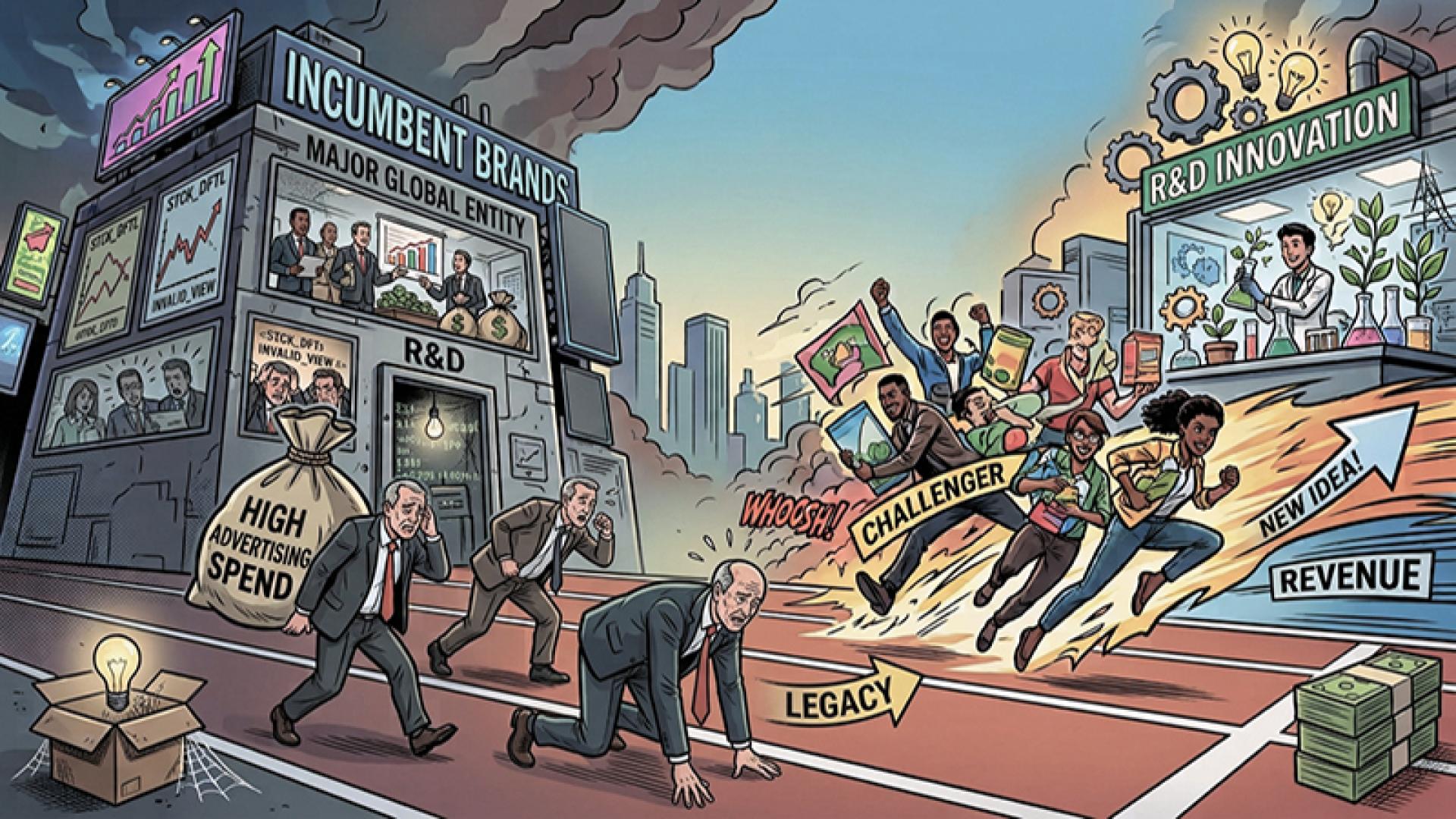
MAJOR BRANDS FACE ESCALATING PRESSURE from faster-moving challengers, say two recent research reports from Boston Consulting Group (BCG) and Barclays, the investment firm. Both research groups found that CPG brands are losing share to upstarts and retailers’ private-label items. The main reason: emphasis on marketing over product innovation has caused them to miss fast-moving trends.
BCG: CPGs’ “lost decade”
In its study entitled, “Processed and Pressured: CPG’s Lost Decade of R&D,” released this summer, BCG found that over the last two decades, advertising and promotion (A&P) spending at most large food and beverage companies has grown twice as fast as research and development.
Collectively, big food and beverage companies invested just 1.5 percent of sales in R&D from 2015 to 2025, well below high-teens rates typical of industries such as pharmaceuticals, consumer electronics, and software according to BCG’s findings. Meanwhile, in 2025 large F&B firms spent between 6 percent to 15 percent of revenues on advertising and promotion.
The BCG study authors opined that for decades R&D underinvestment did not present a problem. Most food and beverage companies pursued a strategy that prioritized scale and marketing muscle. “The bet was that size and strength could keep heritage brands relevant without breakthrough product and ingredient innovation,” they said.
However, BCG argued that consumers are now transitioning toward healthier food and beverage choices at a faster clip than CPG companies can adjust. They cite three underlying influences:
- GLP-1 meds drive awareness of health and nutrition: Active GLP-1 users on average reduce their calorie intake by about 30 percent, with snacking down 40 percent in processed foods, sugar-sweetened beverages, and refined grains. Roughly a third of food spending shifts to nutritional supplements, fitness, beauty, and self-care. BCG estimates more than 30 million U.S. adults will be using these drugs by 2030 as prices decline and generics and new oral formulations arrive.
- Regulatory actions expand around food and diet: A new U.S. food pyramid discouraging consumption of UPFs (ultra-processed foods) and refined grains “mark the beginning of a broader set of policy interventions targeting UPFs,” including potentially adding warning labels and removing UPFs from government-funded food programs (i.e., SNAP), according to BCG. Reducing the long-term medical costs to society of chronic illness is a stated public-health goal of the crackdown on UPFs.
- Shopping apps influence shopper choices: An increasing array of digital- and AI-enabled label-scanning apps (e.g., Yuka, The Food App, Ivy) are providing consumers with real-time access to information on food products to help them prioritize healthier and more nutritional options. BCG wrote, “Increased transparency and comparability mean that product and price differentiation becomes harder to sustain, with digital intermediaries having a greater say in how products are described and assessed.”
BCG estimates those trends have put about $100 billion in major CPG firms’ ultra-processed foods revenues at risk, while also feeding a wave of reformulations and increasing compliance costs. Under-investment in R&D also meant bigger CPG firms lagged on major breakthroughs such a prebiotic soda, plant-based dairy, GLP-1-friendly snacks, and reformulated “clean label” products. Some have ceded market share to smaller, nimbler upstarts as well as to retailers’ house brands.
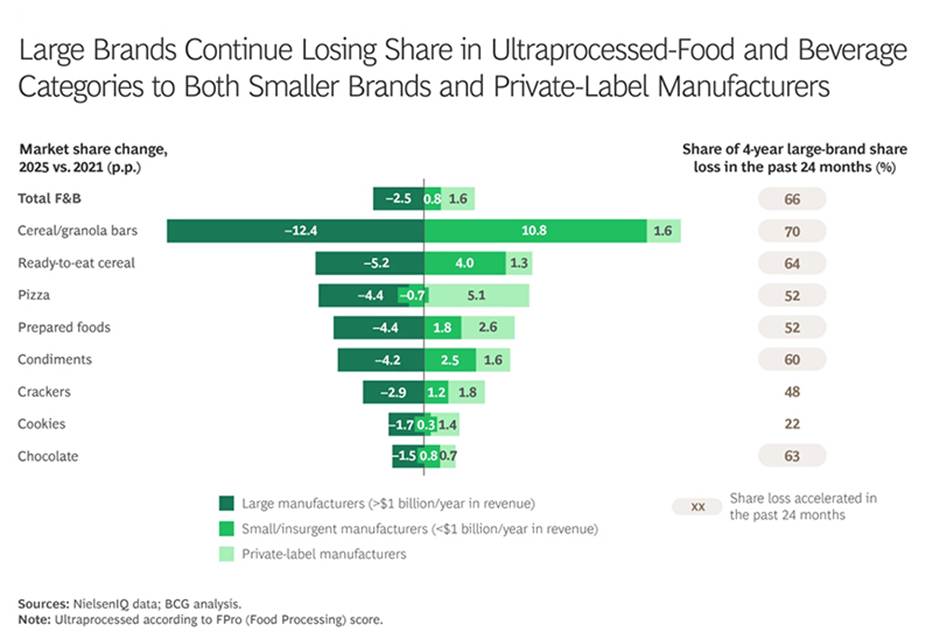
BCG wrote in its study, “Insurgents and retailers are gaining share by staying closer to consumers, paying attention to their needs and preferences, and communicating with them through the channels they use today, such as social media.”
Barclays: The new rules of the FMCG game
Barclays’ “The new rules of the FMCG game,” which was published in January, also questioned whether the high spend on A&P in the broader FMCG space compared to R&D was still paying off, given anemic volume in recent years by many larger players across the sector.
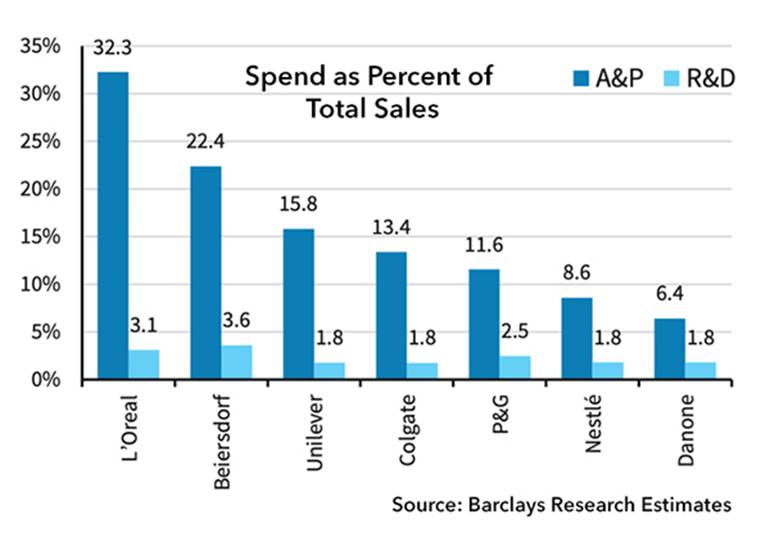
The study identified several other factors that may explain why major CPG players can no longer rely on scale and mass marketing to drive share gains, including:
- The internet’s arrival provided an “infinite shelf” with room for smaller players to grow beyond taking share from store shelves
- The 2008 financial crisis increased consideration for private label alternatives, a trend that has endured
- A 3G Capital-led movement in the 2010s influenced major CPG firms to embrace zero-based budgeting that prioritized margins over long-term growth, strategic investments and innovation
- Supply chain challenges during the pandemic temporarily influenced CPG firms to prioritize refilling stock over developing new products
However, the chief change is the evolving expectations and needs of consumers.
“Consumers are no longer as impression-driven, and high-volume marketing focused solely on brand visibility is no longer sufficient,” analysts led by Warren Ackerman, head of Barclays’ European consumer staples research, wrote in the study. “Consumers today are far more informed, with fundamentally different needs and expectations. They now expect tangible proof of product efficacy and authenticity. Compelling marketing alone cannot bridge this trust gap.”
Ackerman argues that R&D can help firms deliver the science-backed formulations, transparent ingredient disclosure, and sustainable packaging consumers are increasingly looking for. He wrote, “In a world where credibility outweighs advertising intensity, we believe R&D and real science will be the real point of difference between FMCG companies.”
R&D can also help companies catch up to the accelerated shift toward health and wellness and the shift from a "one-size-fits-all" approach toward personalized needs. Ackerman wrote in the study, “A&P spend will always remain crucial in the FMCG industry. However, advertising effectiveness is only as good as brand perception, which is a function of real innovation, which in turn is a function of R&D. We are not convinced that the industry has got the balance between R&D and A&P right.”
Recommended actions
BCG urges F&B brands to conduct a deep assessment of how exposed their products are negatively – or positively – to potential regulatory restrictions or demand shifts, and also make a deeper commitment to transparency. However, the huge task involves “rebuilding the innovation engine,” That includes a reinvestment in R&D internally while turning to M&A to capitalize on emerging “high-potential adjacencies” that tap into unmet needs in the marketplace. Innovation also includes a more comprehensive approach to reformulations that take into account factors such as consumer value, cost optimization, and health and sustainability objectives.
BCG writes in the note, “Reformulation is often treated as a defensive response to regulatory or reputational pressure, but this view is too narrow. Leading companies are institutionalizing a more disciplined product design model.”
Barclays’ Ackerman believes too much emphasis has been placed on the outsourcing R&D and “more of the R&D investment envelope needs to come back in-house, with FMCG companies taking more ownership of the entire R&D ecosystem.”
Ackerman encourages FMCG firms to build up internal venture capital arms to track “early stage, interesting technologies that they do not have access to but could be scaled faster if they are truly differentiated.” He believes AI can play a key role in speeding up product testing and iterations but he generally wants to see R&D earning a higher internal priority, including more R&D leaders reaching boards and the executive level.
Ackerman writes, “In our view, there has been too much focus on renovation, rather than real innovation that consumers will pay up for. Clearly breakthrough innovations are hard and typically more costly, but this is exactly what is needed to cut through in this new consumer paradigm.”