AI Already Picked Its Favorite Brands. Are Yours on its Shelf?
YOU HEARD FROM A FRIEND that magnesium helps with sleep, so you search for it on Amazon.
Hundreds of products come back. You start clicking, and the first surprise is that there is more than one kind: glycinate, citrate, threonate, oxide. A few reviews in, you learn that the forms absorb differently (efficacy) and do different things, one for sleep, another for digestion, another for focus.
Then you find products that blend several forms at once, and others that stack magnesium with something called L-theanine, which you now have to look up too.
Somewhere around comparing prices across a dozen of these, a simple purchase has become an hour of homework.
There is a faster way, and people are taking it: Ask an artificial intelligence (AI) assistant a few questions and let it narrow the field. The harder the category, the more shoppers are doing exactly that. Adobe found that among consumers who shop with generative AI, 73% now treat it as their main way to research a product.1
That should unsettle any brand whose product gets compared before it gets bought. The more research a purchase invites, the more this matters, and price sharpens it: nobody weighs options on a four-dollar sponge, but an eighty-dollar probiotic gets checked against a dozen rivals first.
Measuring The New Shelf
For those categories, the AI assistant's answer is the new shelf, and being left out of it is a new kind of out-of-stock, where the shopper never sees you and never knows they didn't. And the brands the AI assistant’s names are usually not just the ones with the biggest budget or the best-known label.
I started measuring what these assistants actually recommend, the way you would run any audit: ask the questions a real shopper asks, many times over (1,000+ queries), and count who gets named and in what order.
Magnesium, part of the vitamins, minerals and supplements (VMS) world I work in, shows the pattern cleanly. The assistant does not lead with a brand. It leads with form. Say you cannot sleep and it points to glycinate; mention regularity and it moves to citrate; ask about focus and it offers threonate, while steering you off the cheap oxide almost every time.
Only after it has matched a form to your problem does it name brands, and there it turns unforgiving. Across a thousand answers, four clinical, practitioner-grade brands took 72% of every brand mention. A mass-market name most shoppers would recognize appeared in only 8%.2
The assistant has no brand loyalty; it rewards whatever signal the question asks for. Request the best value under twenty dollars and the models swing to mass-market names; ask for the cleanest, most-tested option and they swing back to the premium clinical ones.
What stays constant is the kind of evidence they reach for, almost always a form of proof: third-party testing, clinical backing, real review depth. It recommends the brand that looks most vouched-for, not the one that spends the most.
AI’s Basis for Recommendation
Independent research shows the same tilt, and marks its limit. A 2026 study put identical products to three major models, differing only by brand name, and the known brand won the recommendation 100% of the time.3
That held only at parity. When the products actually differed, the models followed the specifications, which explained 82% of the choice. The trust bias settles a tie, and a real difference on the question that matters breaks it.
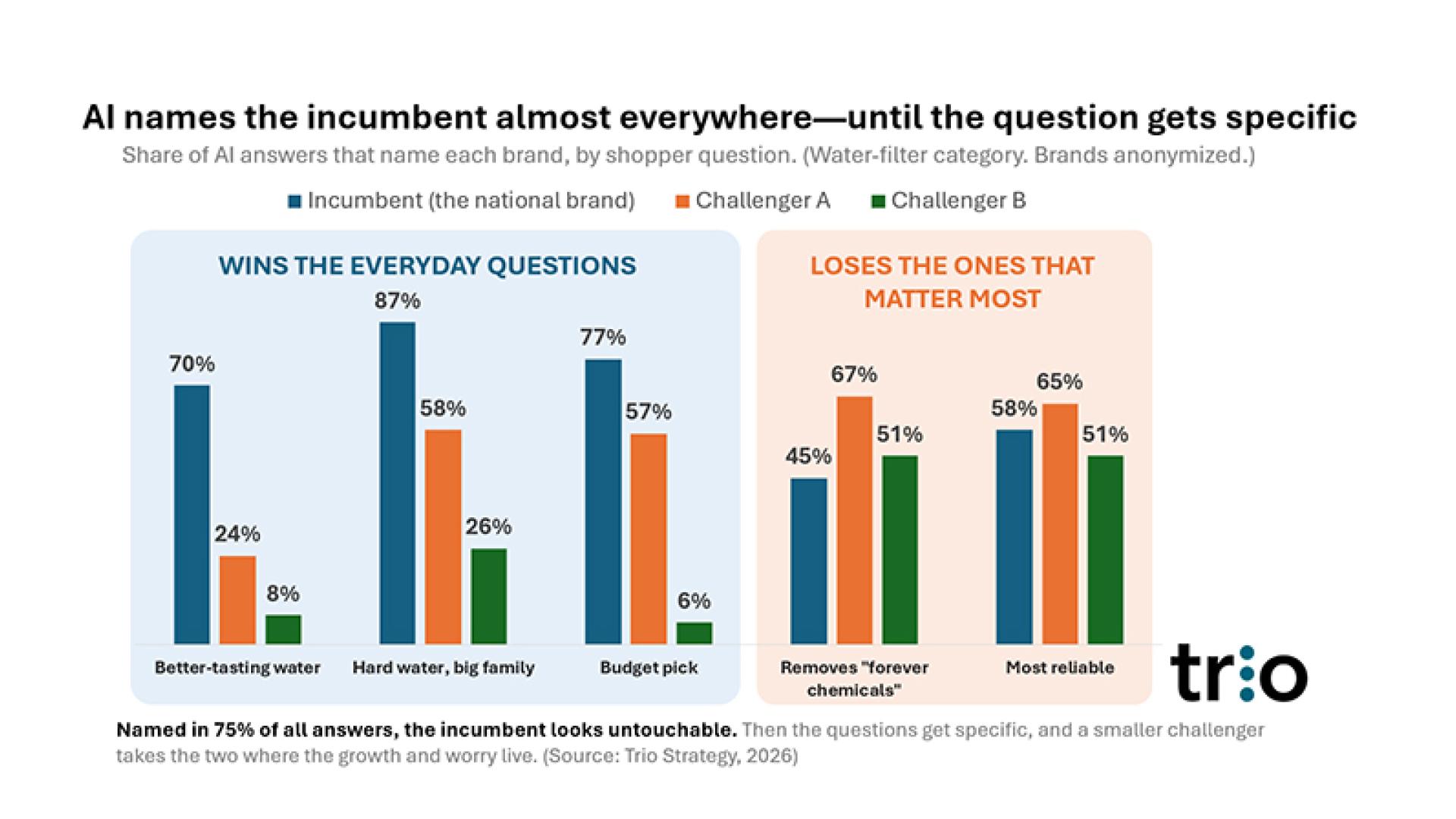
Even a category's runaway leader loses specific questions, and a second category shows how exposed that leaves it. Take water filters, where one national brand looks untouchable: it was named in 76% of all answers and was almost always first.2 Then the questions get specific.
Ask which pitcher removes “forever chemicals” and it drops to third, its share of the recommendation cut roughly in half, behind two smaller specialist brands. Ask for the most reliable low-maintenance option and it loses again. The 76% headline was hiding a set of questions where the default was not the answer.
For a challenger, that is a map. You would not fight the incumbent on “best water filter,” a question it clearly owns. You would attack the questions it loses—the forever-chemicals and reliability searches where both the growth and the anxiety live. You could win those, by backing the claim with the certifications, independent testing and reviews that hold up. For the incumbent, the job is the reverse: find your own blind spots before a challenger does.
GEO Taps Alternate Sources
Any of this depends on knowing where the answers come from, which is rarely a brand's own website (but you should optimize that for LLM readability too). One analysis of 30 million AI citations found the assistants leaning on Reddit, YouTube, Wikipedia, and independent review sites.4 Working those sources deliberately is starting to be called generative engine optimization (GEO).
Timing is the other half, because visibility moves on two different clocks. What a model pulls from the live web can change within weeks. What it has trained into its memory, its sense of which brands are famous, only shifts when the model is rebuilt, over generations. You can move the fast clock now. The slow one hardens against you while you wait.
The honest read for a CPG operator is that AI has already chosen default winners, the tilt toward trusted brands is real and measurable, and it is beatable on the exact questions where you can prove you are better. Waiting is the move that loses, because every month an incumbent spends at the top is another month absorbed into the next model.
The first step costs almost nothing. Pick a category you compete in, ask the assistants the questions your shoppers ask, and count how often you appear and who beats you. Most brands have never run that test because it requires prompting at scale (30+ questions, 4 or more models and 25+ iterations). The gap between what they assume the shopper sees and what the machine actually says is usually the whole conversation.
If you run a consumer brand, the question is no longer whether an algorithm will recommend you. It already does, or it already does not, and most brands have never checked which.
Trey Good spent over a decade between Procter & Gamble and Amazon: brand finance on a $2.2 billion health-and-personal-care business, then four years leading Amazon Private Brands across North America, Europe, and Japan. He now runs Trio Strategy in Manhattan Beach, advising health and wellness brands on commercial and e-commerce strategy. Reach him at trey@triostrategy.io.
Sources:
- Adobe, “Generative AI-Powered Shopping Rises with Traffic to Retail Sites.” business.adobe.com
- Author’s own analysis of AI assistant recommendations across two categories (magnesium supplements and water-filter pitchers), 2026. Methodology available on request.
- "Incumbent Advantage: Brand Bias and Cognitive Manipulation Dynamics in LLM Recommendation Systems,” arXiv, 2026. arxiv.org/html/2606.17443v1
- Profound.com analysis of 30 million AI citations (summary) on linkedin.com