2D Barcodes Move From Retail Pilot To European Reality
FOR DECADES, the barcode did one job extremely well. It identified a product quickly enough for a checkout to process the sale and for a retailer’s systems to manage inventory. That simple function helped create the modern grocery supply chain, but it was designed for a less complicated retail world.
That world has moved on in numerous ways. GS1’s next-generation barcode program is now pushing the industry toward 2D codes, including QR Codes powered by GS1 and GS1 DataMatrix. The ambition behind Sunrise 2027 is that retail POS systems should be able to scan 2D barcodes by the end of 2027, while existing EAN/UPC symbols continue to be used during the transition.
GS1 UK says both symbols are likely to appear on-pack for a period until QR Codes powered by GS1 become widely adopted. A GS1 rep with whom I spoke at the recent Retail Technology Show in London confirmed that the ambition is to achieve industry-wide rollout by 2030 at latest.
"2D barcodes open new opportunities for our brands to interact with consumers," Christian Haensch, MD Beiersdorf Germany and Switzerland
This is about more than different marking on packaging. It is a shift in what product identity means. The old linear barcode points only to a record of a product. However, a 2D barcode can contain far more data and, through GS1 Digital Link, connect a physical product to online information. GS1 describes Digital Link as a standard that can encode identifiers like the GTIN and link them to web-based sources of information.
That creates a single gateway for checkout, operations and consumer information.
In the European market, the timing of the launch is important. Retailers are under heightened regulatory pressure to reduce waste, improve recall accuracy, handle fresh inventory more precisely and support growing demand for transparency.
At the same time, product data is becoming central to ecommerce, retail media, AI search, sustainability claims and future compliance systems.
The 2D barcode sits at the center of those pressures.
The uses include:
- Checkout scanning and price lookup;
- Expiration-date, batch and lot management;
- Targeted recalls and traceability;
- Ingredients, allergens and nutrition;
- Sourcing, recycling and sustainability information;
- Recipes, usage guidance and care instructions;
- Loyalty, promotions and post-purchase engagement;
- Preparation for digital product passports and other data-heavy rules.
This range of uses explains why the subject is no longer confined to packaging or store systems. It now touches data governance, category execution, shopper communication and compliance.
Europe Moves From Tests To Rollout
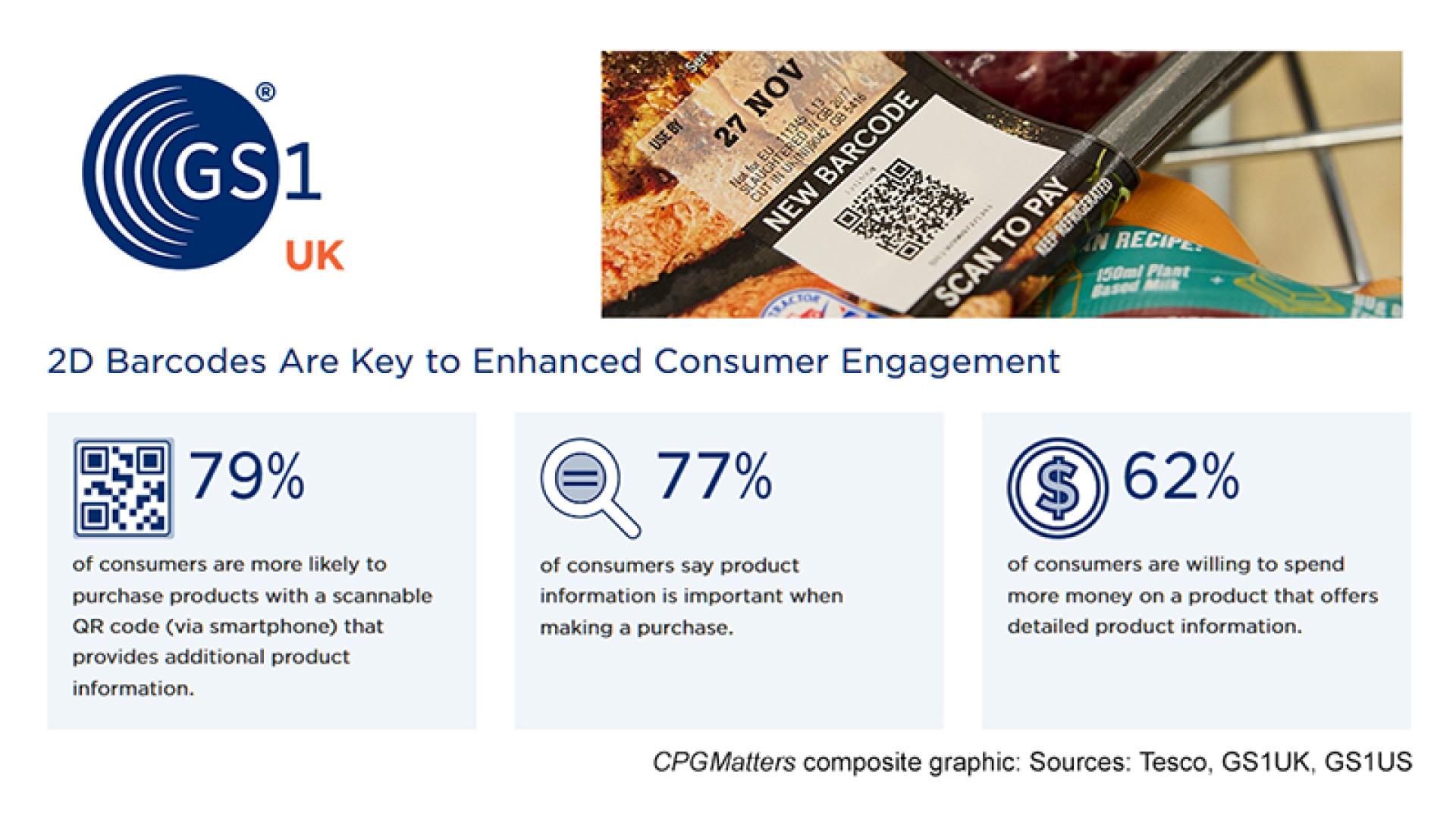
UK market-leader Tesco trialed QR Codes powered by GS1 on selected fresh products, including produce and meat, before moving further in 2026. GS1 UK said Tesco became the first UK supermarket to transition an entire product range to QR Codes powered by GS1, starting with its own-label core sausage range from mid-April. French giant Carrefour has followed suit, placing the new codes on 50 SKUs within its own-brand range.
Fresh food is an obvious place to start. When expiration dates and batch information can be read automatically, stores can improve markdown decisions, reduce waste and make recalls more precise. On the consumer-facing side, that same code can also share product details with shoppers without adding more text to the package.
Germany is also leaning into the new system. Drugstore operator dm has been testing 2D code processing at checkout in select stores, working with GS1 Germany and Beiersdorf. The pilot includes Beiersdorf’s 8X4 deodorants, which are among the first products in the project to use the GS1 Digital Link identification standard.
Christian Haensch, MD Beiersdorf Germany and Switzerland, said the move, “allows us to create tangible added value right at the shelf through transparency and relevant content.” He added that the new codes opened up “new opportunities for our brands to interact with consumers.”
Broad Possibilities
The involvement of dm and Beiersdorf is significant because it shows how the opportunity is not just limited to grocery. Personal care, beauty, household, healthcare and apparel all have strong use cases. Ingredients, safety guidance, instructions, authenticity checks, recycling advice and richer product storytelling can all sit behind one standardized code.
Several pilot participant brands have flagged the latter point as a benefit. The English Soap Company’s brand and marketing manager Kelsey Heaton said the new codes allowed them to “transport” customers to dynamic, product-specific content, while Hillfarm Oils’ Elizabeth Fox called out the GS1 Digital Link solution as “giving Hillfarm’s story the space it deserves” by affording greater freedom for brand storytelling than conventional packaging permits.
GS1 Europe has highlighted QR Codes powered by GS1 and GS1 DataMatrix as key 2D formats that can carry GS1 identification keys and additional product data. Format choice will depend partly on category, package space, regulation and use case.
Other markets are already demonstrating the broader possibilities. GS1 UK’s case studies cite Woolworths Australia, which reduced food waste by up to 40% and improved productivity by up to 21% with 2D barcodes. They also cite 7-Eleven in Thailand as an example of next-generation barcodes being used to support product safety and boost customer engagement.
These examples are worthy of note, showing that standards only become valuable when sufficient participants deploy them consistently.
The Data Work Comes First
The physical code is only the immediately visible aspect of the change. The harder task is ensuring the data behind it is accurate, complete and maintained across markets, retailers and systems.
That means checking core product records, GTINs, variants, package sizes, ingredients, allergens, regulatory details, claims, recycling instructions, images and digital destinations. If those inputs are wrong, the new code will not solve the problem. It will make the weakness more visible.
This is also where the transition links to wider digital commerce. The same product data needed for 2D barcodes is increasingly needed for marketplace listings, retailer product pages, retail media, voice search, AI assistants and sustainability reporting. As L’Oréal France Beauty Tech director Stéphane Lannuzel puts it: “The GS1 enhanced QR code is the door between the physical world, our products and the consumer experience in the digital world.”
In other words, better barcode readiness supports better digital readiness.
The Consumer Scan Still Has To Earn Its Place
There is one caveat. A more capable code does not guarantee consumer engagement.
QR codes have appeared on packages for years, often with uneven results. Too many have led to cookie-cutter websites, expired campaigns or scant promotional content. The GS1 framework should improve consistency, but ultimately shoppers still need a reason to scan.
The best use cases will be practical. A food shopper may want details regarding allergens, provenance, cooking guidance or expiry information. A beauty shopper could want to know about ingredients, tutorials or refill details. A household product shopper might be seeking safety instructions, dosage advice or recycling steps.
Promotions may help build behavior and stimulate usage. For example, a scan could unlock loyalty points, repeat-purchase rewards, cross-category offers or personalized services. But the experience has to be fast, useful and credible. Otherwise, the technology will be technically impressive and commercially underused.
The barcode began as a way to identify products at the register. The next version will help products carry data, prove compliance, support traceability and connect shoppers to digital services.
For CPG companies operating in Europe and beyond, the time to act is now. The 2D barcode is no longer a theoretical, but is already appearing in real stores, on real products and being scanned in real checkout systems.
Those that prepare early will have more control over how the transition works. Those that wait may find themselves changing packaging under pressure while also trying to repair those product data foundations that should have been fixed first.
Howard Lake is a retail commentator with over 14 years’ experience and writes extensively on the retail industry at his Retail Slop Substack. howardlake@virginmedia.com