Spotlight on the Future Consumer: $20T in Spending Up for Grabs
By 2036, consumers will have reevaluated their relationship with trust, time, and social connections. What this means for brands:
● $20 trillion worth of consumer spending will be exposed due to trust failures.
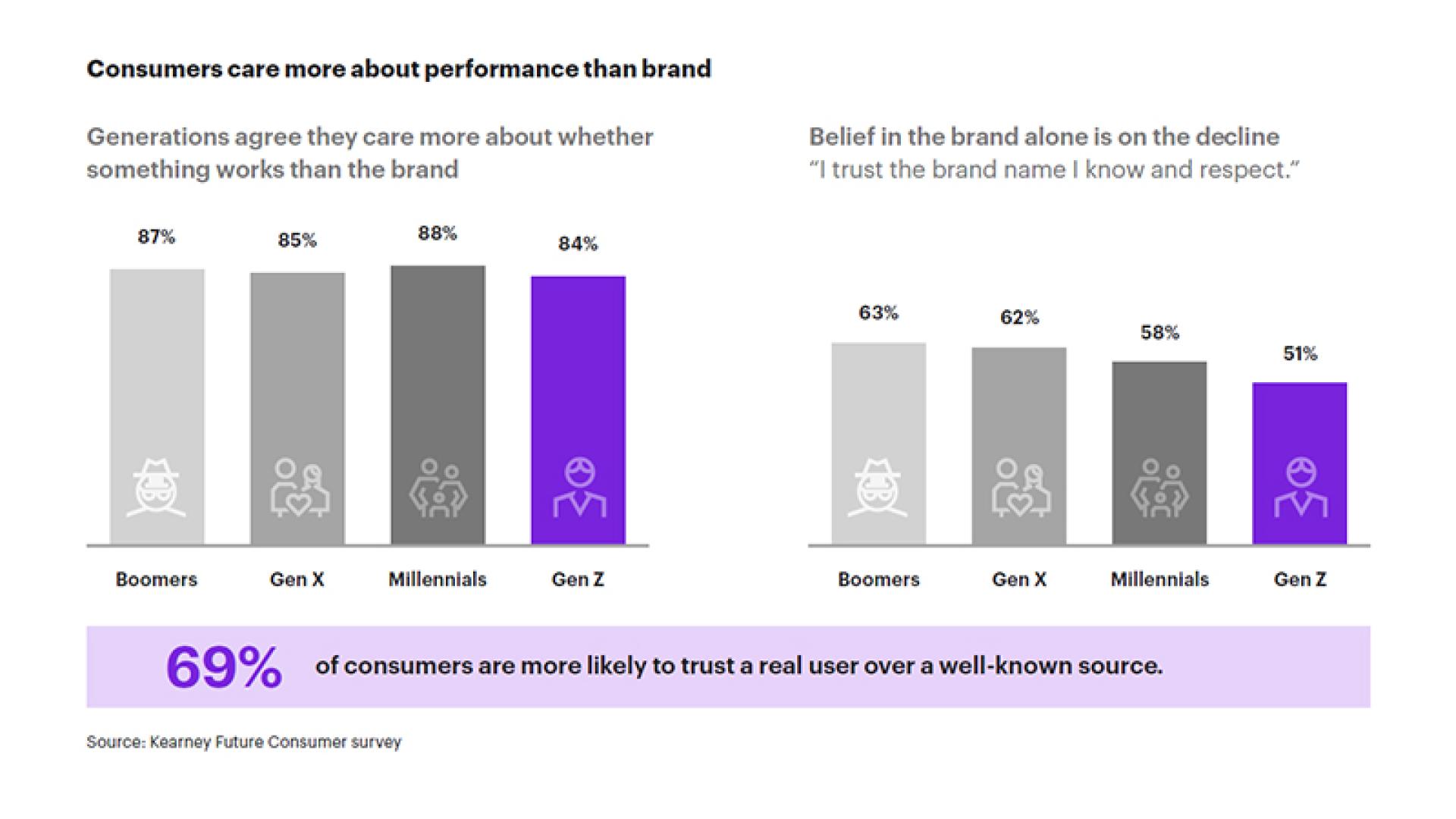
● Trust shifts from a source-based to outcome-based model, dependent upon consistent performance.
● Eighty-six percent of consumers agree they care more about whether something works than the brand.
The Kearney Consumer /Institute (KCI), an internal think tank of global strategy and management consultancy Kearney and part of the Kearney Foresight network, today released a landmark global study on the future consumer, The tyranny of too much, predicting that by 2036, brands will be competing for consumers who can’t keep up with the compounding of choice, convenience, and personalization and who face a flood of options, inputs, tasks, and interactions. This “compounding effect,” as the report notes, has often transferred additional work on to consumers, rather than making life easier.
Based on a survey of 21,500 consumers across 20 countries, the report explores likely changes in consumer behavior a decade from now, focusing on brand trust, a shifting sense of time, and social interactions that have gone from physical to synthetic. “In significant ways, consumers will not know how to live in the world they have helped create,” notes KCI lead Katie Thomas, principal author of the report. “By 2036, demographic change, macroeconomics and policy, and technology will shape who holds spending power, how much flexibility consumers have, and how willing they are to reconsider established habits.”
Trust is a major theme explored in the study, which estimates that up to $20 trillion in consumer spending will become contestable in 2036 as brand switching accelerates. “With near-unlimited access to information, some real and some not; people, some real and some not; and product claims, some real and some not, who will consumers trust?” posits Katie Thomas. “The old model of trust was based on institutions and defined by a set of experts, media, and leading brands. Now and in the future, with consumers having access to more self-acquired information, trust will shift from brands and sources to outcomes and performance. It’s no surprise that we’re seeing so many ‘broken trust’-led brand boycotts.”
Access the full KCI Global Future Consumer Study report here.
When consumers can no longer grant trust by default, every decision demands more evaluation on which claim is real, which product will work, and which agent can help decide. That work comes out of time, already fragmented by a world that offers more to do, monitor, and manage. “Automation and changing norms may free up time, but that time is quickly reabsorbed or redirected,” says Greg Portell, Kearney partner and global markets lead. “The result is a more fragmented, multitasking-driven consumer experience. From product discovery and media consumption to the growing desire for rest, these shifts are reshaping how people spend their time and how brands earn their attention.”
The KCI Global Future Consumer Study delves into the ways AI and technology will change social behavior. According to Katie Thomas, “Greater use of AI may change how people allocate attention and seek connection. We already see consumers becoming more willing to use AI for personal and emotional interactions, though most still believe the core elements of human connection can’t be replicated by technology. They may become comfortable delegating emotionally charged questions to AI, creating potential disappointment or misdirection for both consumers and brands.”
Finally, the report provides direction on how brands should fundamentally redesign their relationship to consumers accordingly. “Compounding forces have transferred much of the work of verification, coordination, and connection on to consumers,” offers Rhiannon Thomas, partner and global lead of Kearney’s consumer and retail practice. “Brands need to evaluate how the shift in trust from source-based to outcome-based will affect them and will need to put the outcome in consumers’ hands. They will need to give back time through interface and automation, preserving room for discovery and creating communal value.”
About the Kearney Future Consumer Study. Conducted in May 2026, the Kearney Consumer Institute Global Future Consumer Study covered 20 countries with 21,500 total respondents. The major regions—the Americas, Europe, the Middle East and Africa, and Asia Pacific—included nations with large, youthful populations, nations with aging populations, emerging economies, and established Western markets. Countries surveyed: Australia, Brazil, Canada, China, France, Germany, India, Indonesia, Italy, Japan, Mexico, Nigeria, Poland, Saudi Arabia, South Africa, South Korea, Thailand, United Arab Emirates, United Kingdom, and the United States. The survey addressed topics of trust, time, and social connection. It included broader behavioral and attitudinal questions on product discovery, social media, financial security, and technology. Given the forward-looking nature of the report, the age distribution skewed younger, with millennials and Gen Z in the majority, and a census-appropriate representation of gender and income groups in each market.