Cuckoo For Alt-Cocoa: Investment is Re-Shaping the Chocolate Industry
CHOCOLATE INSPIRES PASSION among vast numbers of consumers and the companies that bring it to market.
But fulfilling that passion at scale carries significant costs — financial, environmental and ethical.
Beset by multiple pressures, the global chocolate market is experiencing a sweeping transformation, as a wave of entrepreneurs vie to bring cocoa alternatives to consumers. No longer regarded as fringe projects from eco-conscious outliers, artificial or alt-cocoa is attracting significant capital investment from some of the world’s largest ingredient companies.
Worldwide chocolate sales are projected to reach $131.7 billion in 2026, according to Grandview Research. Sector growth is being boosted by a new range of artificial products, forecast to expand at a CAGR of 9.6% in the next seven years.
Read more about the economics behind the world cocoa industry in CPGMatters' previous article: What's Next for Chocolate Culture?
Behind the alt-cocoa surge are a trio of global market forces that has mobilized the entire industry:
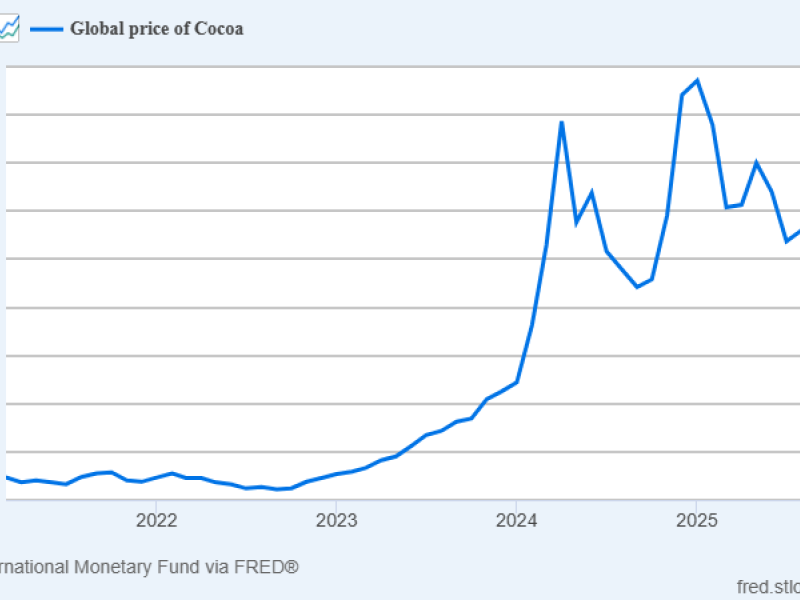
Supply and cost issues have rattled the industry for several years, as environmental change and political instability in West African, Latin American and South Asian producer countries created a massive price spike in 2024. While prices have settled somewhat, consumer demand is growing throughout the world. For large-scale producers of packaged chocolate confectionary and other products that use cocoa and cocoa butter as ingredients, the uncertainty of cost and availability seems to demand strategic response.
Ecology advocates have long fretted about damage wrought by cacao monoculture in the narrow band of the planet where the plants can thrive. Crop fluctuation due to climate change is making cacao production riskier for small farmers and contributed to supply uncertainty. Some fields have reportedly failed in Côte d’Ivoire and Ghana, the world’s two largest producing countries. The production of palm oil, used widely in chocolate formulation, carries with it added environmental harm, and some activists are pushing back.
Ethical concerns also enter the equation, as independent growers account for most cacao production. In the two West African nations, workers’ average pay is reportedly less than $1 per day. Farmers can be highly vulnerable to predatory middlemen, and price fluctuations, not to mention weather changes. Alleged use of child labor by some growers has brought criticism in social justice circles.
Upcycling versus Cell Cultivation
Concerns about cost and future scarcity have been driving invention and development of cocoa alternatives for several years, many backed with investment capital from larger confectionary manufacturers.
Those manufacturers are motivated by three requirements:
- Predictable supply and stable cost and to meet expanding demand
- Convincing flavor, consistency and mouth feel
- One-to-one substitutability in recipes and manufacturing processes.
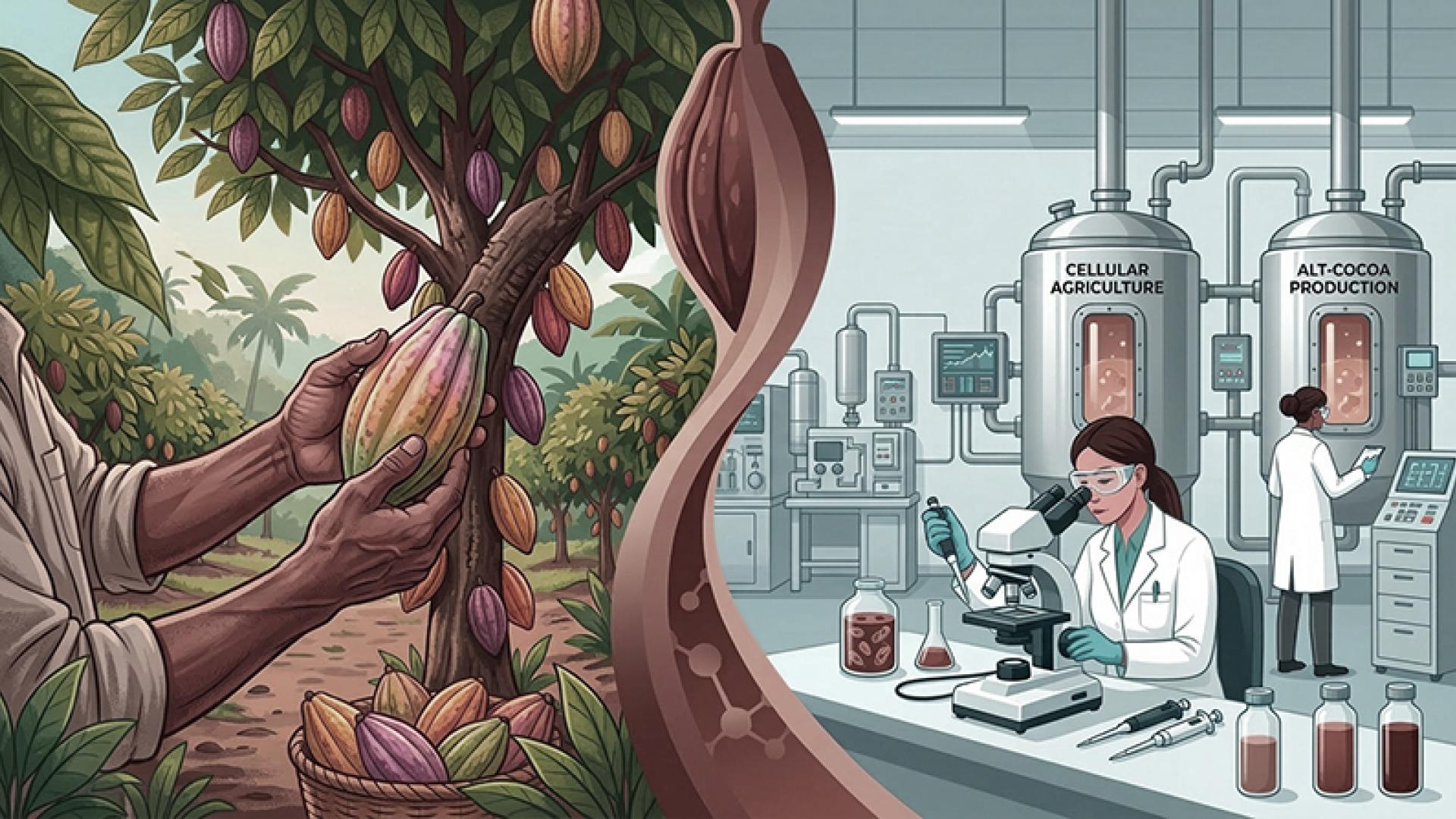
New alt-cocoa ingredients are being produced using two primary approaches: cocoa-free alternatives (made by upcycling seeds, legumes, and oats) and lab-grown (cell-cultivated) cocoa.
Upcycled plant sources, like fava beans, carob pods, grains, seeds and cocoa plant side-streams, are roasted and processed to create flavor profiles which producers claim are indistinguishable from real cocoa—or at least close enough for some product formulations.
Alt-fats are also being formulated from plant sources to resemble natural cocoa butter in flavor, mouth feel and performance.
Cell-cultured ingredients, grown in controlled lab environments using cacao beans and side-sources like pod hulls, are intended to be bio-equivalent to natural cocoa and cocoa butter. Innovators claim these products are indistinguishable from natural chocolate and can be produced very near to major consumption markets with minimal environmental impact, at competitive cost.
Who’s Funding Who in Alt-Cocoa
Alt-cocoa is already a big business. The roster of inventors and investors has surged rapidly around the world since the 2024-25 price spike roiled world markets. Following is a rundown of some major players compiled by CPGMatters from public sources:
- Cargill (US) began publicizing its NextCoa cocoa substitute in May of this year, following its investment in Voyage Foods. The company says it is made from plant-based ingredients like grape seeds, and promises to improve pricing stability and availability. “The product also delivers measurable environmental benefits, including a 67% lower carbon footprint compared to conventional chocolate,” the company says.
- Fermtech (UK) said it raised £2.5M in seed funding last April that it will use to scale its Koji Cocoa technology. Its process ferments cocoa “side streams” (normally-discarded parts such as husks, etc.) to make a useful product with natural flavor components, the company says.
- Fazer Group (Finland) introduced a cell-culture cocoa product in 2022 in response to concerns about climate change. Its base ingredients are malted grains. The company markets a range of confections aimed at the consumer market, including Dumle cocoa-free wafer bars.
- Foreverland (Italy) has introduced a product Choruba (formerly branded as Freecao), processed from carob, which is grown widely in its home region. Carob pods are primarily grown for their seeds, which are processed into locust bean gum. The company raised €3.4 million from institutional backers, led by CDP Venture Capital in Italy.
- Kokomodo (Israel) came on the scene in 2024 with a seed investment from The Kitchen FoodTech Hub by Strauss and the Israel Innovation Authority. It produces alt-cocoa using plant cell culture process.
- Lindt & Sprüngli AG (Switzerland) is investing in several alternative cocoa technologies, notably a seed investment in Zurich-based Food Brewer which uses cell culture to grow bio-equivalent cocoa. Lindt has previously partnered with Planet A Foods and used its ChoViva alt-cocoa in a limited-edition vegan candy bar in 2023.
- Mars, Inc. (US) is pursuing several strategies intended to ensure a sufficient and sustainable future cocoa supply. It has licensed a process from biotech firm Pairwise, to use gene-editing techniques to modify cocoa plants to produce greater yields. It has also incorporated Planet A Foods ChoViva ingredient in its Balista bar presently test marketed in Germany.
- Mondelēz International (US) has made investments in alt cocoa through its venture capital firm, SnackFutures Ventures. It is a backer of Cellest Bio, an Israeli food-tech startup focused on developing cell-cultured cocoa butter, described as “cell suspension culture technology.” In April of this year Mondelez introduced its first consumer chocolate bar using the cultivated cocoa butter. The company claims “identical quality” to conventional cocoa.
- Nukoko (UK) was acquired in 2024 by Döhler the giant food ingredients supplier in Germany, to expand cocoa-free chocolate capabilities. Nukoko uses fava beans as a source ingredient, offering resilient, scalable alternative chocolate supply. It claims a 1 to 1 replacement ratio in recipes. Favas are grown across Europe and are regarded as an environmentally friendly crop.
- Planet A Foods (Germany), product uses a fermentation process to make ChoViva, from roasted sunflower seeds and oats to create a cocoa alternative that Nestlé has already begun using in at least one product. Swiss chocolate giant Barry Callebaut announced last November that was investing to help bring ChoViva to markets worldwide.
- Puratos (Belgium) the major food ingredients group, is reportedly backing California Cultured, which makes cultured cocoa using a fermentation process, to make commercial quantities of cocoa powder.
- Win-Win (UK) markets a variety of packaged cocoa-free chocolate alternatives in its home market, intended for one-to-one substitutions in baked goods and confections. Founded in 2022, the company’s products use fermented barley as a foundational ingredient in the finished product.