Storm Clouds on the CPG Horizon: Private Brands Rewrite the Go-to-Market Playbook
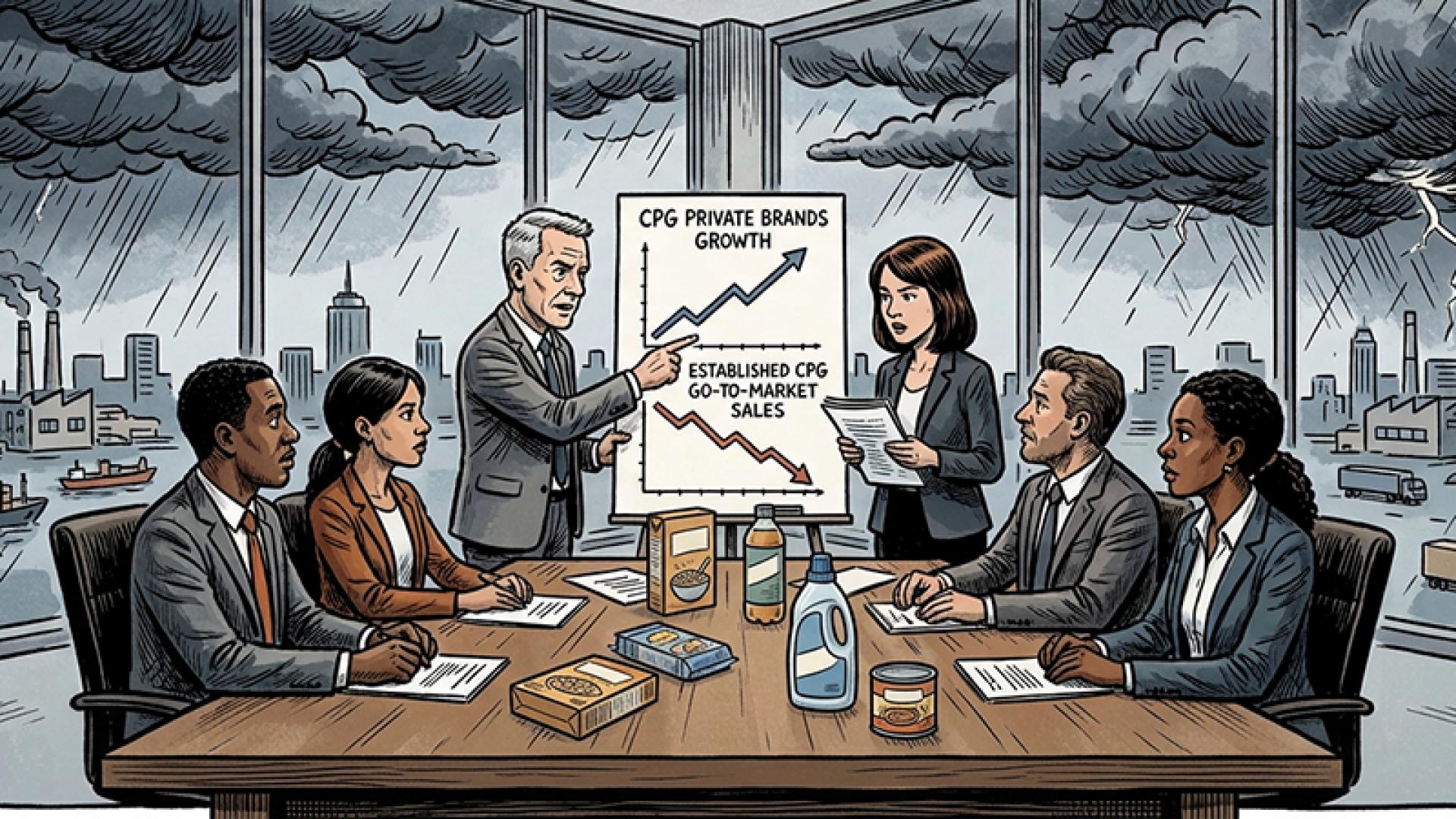
A DECISIVE POWER SHIFT is reshaping the consumer-packaged goods industry. Retailers are no longer using private brands as a defensive price lever or a secondary shelf alternative. They are building integrated, high-performance brand platforms that combine first-party shopper data, retail media, supply chain control, category intelligence, and faster innovation cycles to capture a larger share of consumer spending and category economics.
The strategic consequence is a fundamental redistribution of power across the CPG value chain. Competition will no longer be defined primarily by manufacturer versus manufacturer; it will increasingly be defined by manufacturer versus retailer. The retailer increasingly controls the decisive commercial assets: the shelf, shopper data, retail media channels, transactions, and the point of demand creation, while also owning their own brand value proposition.
In this model, private brands are not simply products on the shelf; they are instruments of retailer control over category economics, consumer loyalty, and the definition of value.
Retailers are becoming brand builders at scale
Private brands have moved decisively beyond their historical role as entry-price alternatives with generic packaging. Leading retailers are now building tiered brand portfolios that compete across the full consumer value spectrum, from essential value and everyday quality to premium indulgence, health and wellness, convenience, beauty, pet care, household solutions, and restaurant-quality experiences at home.
These are no longer just “private brands.” They are purpose-built consumer propositions, designed with differentiated identities, elevated packaging, credible performance claims, and sharply defined need states. The strongest retailers are using private brands to shape category demand, create exclusive reasons to shop, and capture greater control over both consumer loyalty and category economics.
A transformed competitive model
That is a fundamentally different advantage from the one retailers held a decade ago.
National brands once owned the demand engine: they built awareness through advertising, shaped category expectations through innovation, and used scale to secure broad distribution. Retailers controlled access to the shelf, but manufacturers often retained greater influence over the consumer narrative.
That boundary has now collapsed. Retailers increasingly control transaction data, loyalty relationships, digital storefronts, retail media networks, shelves, and, through private brands, the product proposition itself.
This creates a formidable new competitive model. Retailers can detect an unmet need, validate it through shopper signals, test an offer digitally, target the most relevant households, and scale it rapidly through preferred shelf placement and owned media. For CPG companies constrained by fragmented data, slower innovation cycles, and legacy go-to-market models, the threat is not incremental. It is structural: a reallocation of demand creation, category influence, and profit power toward the retailer.
The retailer’s advantage is not merely lower cost. It is preferential economics.
Retailers will systematically tilt the category toward private brands through preferred shelf placement, personalized loyalty offers, stronger search visibility, owned digital media, and assortment rationalization that removes weaker branded alternatives.
For CPG companies, the risk extends beyond lost volume. It is the loss of strategic relevance in the retailer’s category plan. Once a brand no longer drives traffic, innovation, or margin, it becomes vulnerable to reduced distribution, lower promotional priority, and diminished negotiating power.
Private brand is the new retail growth engine
The strongest retailers are building private-brand advantage across five reinforcing capabilities.
- First, retailers are using first-party data to identify and monetize category white space faster than traditional manufacturers, translating household, store, and segment-level signals into targeted propositions across value, wellness, convenience, and premiumization.
- Second, retailers are accelerating private-brand innovation, using supplier ecosystems and rapid development models to convert emerging demand into market-ready propositions before national brands establish emerging categories.
- Third, retailers are converting retail media into a private-brand demand engine, using first-party data to reach shoppers at the moment of decision, personalize conversion, and turn owned-brand marketing into a measurable source of growth.
- Fourth, retailers are redesigning category architecture around owned-brand economics, using private brands to anchor value tiers, premium platforms, wellness propositions, and exclusive innovation that reduces direct comparability and strengthens margin control.
- Fifth, retailers are building private brands with emotional relevance, creating trusted, distinctive propositions anchored in the consumer’s highest-priority needs, from family value and wellness to indulgence, convenience, and discovery.
Private-brand momentum will persist well beyond inflation because it is no longer fueled primarily by consumer trade-down. It is being powered by a structural retailer advantage: superior shopper data, faster innovation, owned media, tighter category control, and the ability to convert insight into demand with greater speed and precision.
CPG imperatives: Move from brand defense to category offense
The response cannot be a generic call for more innovation or more trade spending. CPG leaders need a disciplined offensive agenda on multiple fronts:
- Identify where your brand is truly irreplaceable. Every brand should be tested against a hard question: if a retailer introduced a private-brand alternative tomorrow at a 20 percent lower price, or a premium private-brand product with superior formulary, why would consumers still choose our brand? The answer must be specific and evidence based. Superior efficacy, differentiated ingredients, proprietary technology, sensory superiority, trusted performance, emotional relevance, or category authority are defensible advantages. Familiarity alone is not.
- Redesign innovation around speed and proof. Traditional annual innovation calendars are too slow. CPG companies need faster testing models, smaller launch cycles, rapid consumer feedback, and the ability to scale successful products quickly. Innovation must become a continuous capability, not a once-a-year launch event.
- Build retailer-specific growth strategies. Having a national brand strategy alone is no longer enough. The strongest manufacturers will create retailer-specific plans that reflect each customer’s shopper base, private-brand agenda, retail-media capability, category priorities, and operating model. The goal is to become essential to the retailer’s growth agenda, not merely present in its assortment.
- Use retail media to create measurable demand. Retail media should not be treated as another trade-spending line item. It should be used to drive trial, build repeat purchase, defend key shopper segments, and prove incremental category growth. CPG companies that cannot demonstrate a measurable return on investment in retail media will lose influence as retailers allocate attention to their own brands.
- Protect the shelf through superior execution. The battle will increasingly be won at the point of availability. Out-of-stocks, poor digital content, weak search visibility, inconsistent pricing, and missed promotional execution create immediate openings for private brands. Manufacturers need store-level and digital shelf visibility to identify and correct execution failures before they result in lost loyalty.
- Compete for the category profit pool, not just brand share. Retailers will favor suppliers that help grow the category, improve shopper retention, reduce complexity, increase margin, and strengthen execution. CPG companies must show how their brands create incremental value, not simply how they protect their own volume.
Summarizing the realities facing CPG leadership
The private-brand challenge is not whether retailers will continue to grow their owned brands. They will.
The defining question is whether CPG companies will respond with enough urgency to remain strategically indispensable.
The next era of competition will not be won by the brands with the largest historical share. It will be won by companies that can move faster, innovate more meaningfully, use data more intelligently, and create a stronger reason for both retailers and consumers to choose them.
Retailers are raising their go-to-market game. CPG companies now need to decide whether they will defend the past or build the capabilities required to win the future.
How will you compete as a brand?
 Thom Blischok serves as Chairman and CEO of The Dialogic Group, LLC, where he provides strategic guidance to leading retailers, technology innovators, consumer packaged goods companies, and investment firms specializing in retail transformation, artificial intelligence/robotics, operations, and consumer engagement